HANDLOOM SAREES · UNSTITCHED SUIT MATERIALS · SOURCED DIRECTLY FROM WEAVERS · FREE SHIPPING ACROSS INDIA

Types of Handloom Sarees in India: A Region-by-Region Guide

Weave Spotlight · The Overview
Types of
handloom sarees.
The main types of handloom sarees in India, grouped by region and method, with a guide to each, from Kanjivaram and Benarasi to Chanderi, ikat and block prints.
8-minute read · Weave Spotlight
India has dozens of handloom traditions, and the easiest way to learn the types of handloom sarees is region by region. Here is a map of the main ones, with a full guide to each.
01 — The big picture
Types of handloom sarees: by region, by method
India has dozens of handloom traditions, and the easiest way to understand the types of handloom sarees is by where they come from and how they are made. Some are woven with the pattern in the loom, some are dyed before weaving, and some are painted or printed by hand on handwoven cloth. This guide groups the main types by region, and links to a full guide for each.
02 — The south
South India: temple silks and light cottons
Tamil Nadu
Kanjivaram, the temple silk
Heavy pure silk with real zari and bold temple borders, woven in Kanchipuram. The classic wedding saree.
Andhra Pradesh and Telangana
Mangalgiri, Kalamkari, and Pochampally
Mangalgiri is a crisp, affordable cotton, Kalamkari is hand-painted or block-printed, and Pochampally is a famous ikat.
03 — The east
East India: fine cottons and wild silk
Bengal
Jamdani and Kantha
Jamdani is a fine, sheer cotton with motifs woven in, and Kantha is running-stitch embroidery on cotton or silk.
Odisha, Jharkhand and Bihar
Sambalpuri ikat and tussar
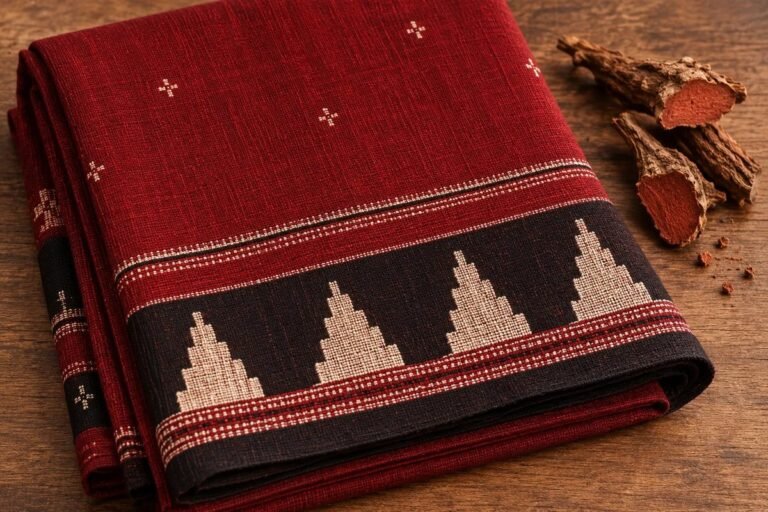
Sambalpuri is an ikat with conch and wheel motifs, tussar is wild silk with a natural golden colour, and Kotpad is natural-dye cotton from southern Odisha.
04 — The west
West India: double ikat and tie-dye
Gujarat and Rajasthan
Patola, Bandhani, Leheriya and block prints
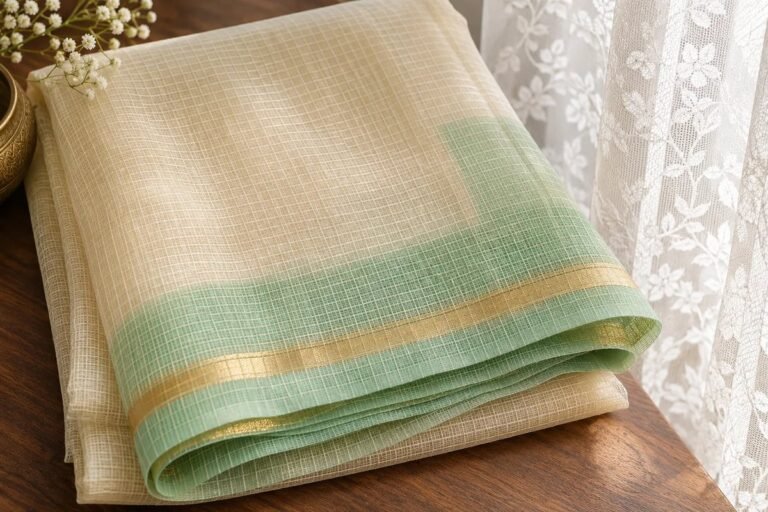
Patola is a rare double ikat, Bandhani and Leheriya are tie-dyes, and Bagru and Ajrakh are block prints. Kutch’s Bhujodi is a textured handwoven cotton, and Kota Doria from Rajasthan is a featherlight cotton-silk check.
Maharashtra
Paithani, the peacock silk
A tapestry-woven silk with peacock and lotus motifs, known for its rich zari.
05 — The centre and north
Central and North India: Benarasi and Chanderi
Uttar Pradesh
Benarasi, brocade silk
Rich silk brocade with intricate zari, woven in Varanasi, a favourite for weddings.
Madhya Pradesh
Chanderi and Maheshwari
Both are light, elegant handlooms. Chanderi is sheer and delicate, and Maheshwari is crisp with striped bodies.
Woven, dyed, or printed?
Woven types, such as Kanjivaram, Jamdani and Paithani, build the pattern into the cloth. Dyed types, such as ikat and Bandhani, set the colour in the yarn or cloth. Printed types, such as Bagru and Kalamkari, apply pattern by hand to woven cloth.
06 — Choosing
How to choose among the types of handloom sarees
Choose by occasion first: a silk or brocade for weddings, a light cotton or silk-cotton for daily wear, and a print or ikat for personality. Then check the price, since each weave has its own range; our price guide lists them. Our guide to telling a real handloom from a fake and the note on handloom versus powerloom help you buy safely, and what a GI tag means explains the labels on many traditional weaves. The full field guide is on our Craft page.
07 — Common questions
Quick answers
What are the main types of handloom sarees in India?
Among the best known are Kanjivaram, Benarasi, Jamdani, Patola, Paithani, Chanderi, Maheshwari, Mangalgiri, Pochampally, Sambalpuri, Bandhani, Kantha, Bagru, Ajrakh, Kalamkari and tussar.
Which handloom saree is best for daily wear?
Light cottons and silk-cottons, such as Mangalgiri, Chanderi, Maheshwari and Pochampally cotton, are comfortable and affordable.
Which handloom saree is best for weddings?
Kanjivaram, Benarasi, Paithani and Patola are the classic wedding silks.
What is the difference between ikat and block print?
Ikat is tie-dyed in the yarn before weaving. Block print is stamped by hand onto finished cloth.
Not sure which type to choose?
Tell us the occasion, your budget and your favourite colours over WhatsApp, and we will suggest the types of handloom sarees that suit you.