HANDLOOM SAREES · UNSTITCHED SUIT MATERIALS · SOURCED DIRECTLY FROM WEAVERS · FREE SHIPPING ACROSS INDIA

Leheriya Saree Guide: Rajasthan’s Wave Tie-Dye

Weave Spotlight · The Craft
Leheriya saree:
waves of colour,
made for monsoon.
Rajasthan’s diagonal wave tie-dye — how the pattern is actually created, why it’s tied to Teej and monsoon festivals, and what to check before you buy.
6-minute read · Weave Spotlight
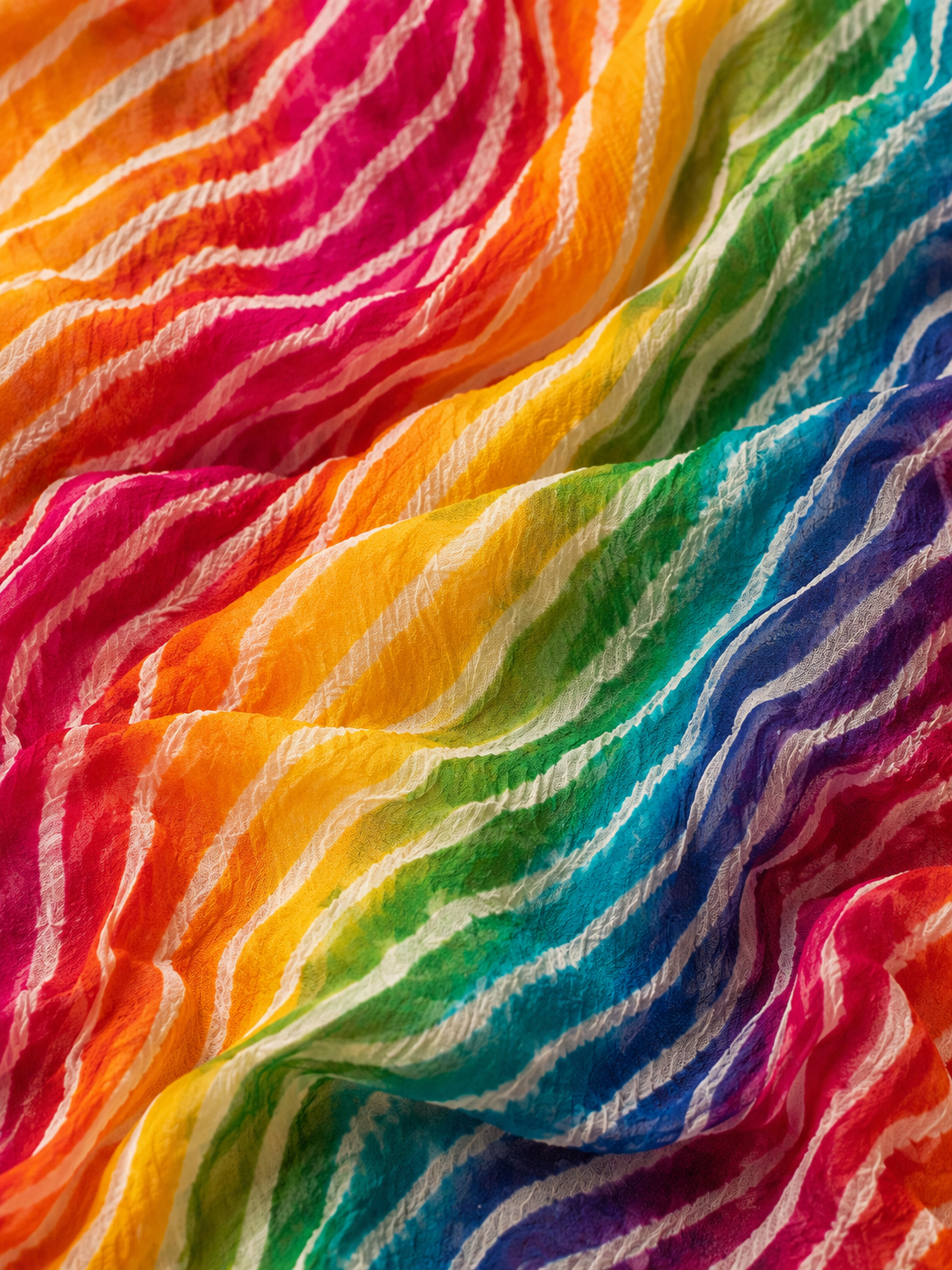
“Leher” means wave, and a genuine Leheriya saree earns that name honestly — the diagonal stripe pattern comes directly from how the fabric is rolled and tied before dyeing, not from anything printed on afterward. A Leheriya saree is one of the most immediately recognizable tie-dye traditions in India, and one of the easiest to get wrong when buying online.
01 — Origin
Where Leheriya comes from
Leheriya is rooted in Rajasthan, particularly Jaipur and Jodhpur, where the technique has long been associated with the desert state’s festival calendar. It carries particular cultural weight around Teej and the monsoon season — a time of celebration in a region where rain is genuinely scarce, and the wave motif itself is often read as a symbolic nod to water and the monsoon.
02 — How it’s made
Leheriya saree: rolled, then tied
Unlike Bandhani’s small individual dot-ties, Leheriya works by rolling the fabric diagonally into a tight coil, then tying it off at intervals along the roll before dyeing. When the fabric is later untied and unrolled, the tied sections resist the dye, leaving the diagonal stripe pattern that gives Leheriya its name.
More complex variations exist, including “Mothra” (a grid-like variant made by rolling and tying in two directions) and multi-colour Leheriya, which layers several rolling-and-dyeing passes to build up more elaborate stripe combinations.
Seasonal by nature
Unlike most weaves on this list, genuine Leheriya production has historically followed a seasonal rhythm tied to festival demand, particularly around Teej and monsoon celebrations — meaning availability of new, freshly made pieces can genuinely fluctuate through the year in a way it doesn’t for, say, Kanjivaram.
03 — How to tell it’s genuine
What to check
- Look closely at the stripe edges. Genuine tied-and-dyed stripes have a very slight softness or blur at the edges, since the resist isn’t a perfectly sharp mechanical line. Printed imitations show harder, crisper stripe boundaries.
- Check the fabric for the diagonal roll pattern. Because the technique relies on rolling the fabric before tying, genuine pieces sometimes retain subtle diagonal texture even after unrolling — a flat, textureless base under printed stripes suggests a shortcut.
- Question suspiciously uniform stripe width. Hand-tied Leheriya has natural minor variation in stripe spacing across the fabric — perfectly even, ruler-straight stripes throughout are a signal of digital printing.
- Ask about the base fabric. Traditional Leheriya is done on lightweight cotton or georgette — heavier or synthetic-feeling fabric claiming to be Leheriya is worth a second look.
04 — What it costs
A rough price guide
| Type | What it means | Typical price |
|---|---|---|
| Printed synthetic, “Leheriya style” | Machine-printed stripes on chiffon or synthetic base | ₹700 – 1,800 |
| Hand-tied Leheriya, cotton/georgette | Genuine roll-and-tie technique, single colour pass | ₹2,500 – 6,000 |
| Multi-colour or Mothra Leheriya | Multiple dyeing passes, more complex pattern | ₹7,000 – 15,000+ |
05 — Wearing and caring for it
Once you own one
Leheriya’s light, breathable base fabric and festive palette make it a natural fit for daytime celebrations, particularly around monsoon-season and Teej-related events where it carries the most cultural resonance. It works well with minimal, understated jewellery since the diagonal stripe pattern is already visually strong on its own.
Hand-wash cold and separately, especially for the first couple of washes given the dye process, and air-dry flat rather than wringing to protect the resist pattern. Avoid harsh detergents, which can dull the vibrancy that’s central to the fabric’s appeal.
06 — Common questions
Quick answers
What’s the difference between Leheriya and Bandhani?
Both are tie-dye techniques from the same broader region, but Bandhani ties thousands of tiny individual points to create dots, while Leheriya rolls the fabric diagonally and ties it at intervals to create wave-like stripes — different tying method, different resulting pattern.
What is Mothra Leheriya?
A more complex variant made by rolling and tying the fabric in two directions instead of one, producing a grid or checkered pattern rather than simple parallel stripes — generally more time-intensive and priced higher.
Is Leheriya only worn during monsoon season?
It carries the strongest cultural association with monsoon and Teej festivities, but it’s worn more broadly for festive daytime occasions throughout the year, not exclusively during the monsoon months.
Looking for genuine Leheriya?
We post hand-tied pieces in the WhatsApp circle as they arrive from Rajasthan — real waves, real colour, no printed shortcuts.