HANDLOOM SAREES · UNSTITCHED SUIT MATERIALS · SOURCED DIRECTLY FROM WEAVERS · FREE SHIPPING ACROSS INDIA

Bagru Print Guide: Mud-Resist Block Printing

Weave Spotlight · The Craft
Bagru print:
made with
fermented mud.
A Bagru saree gets its soft, earthy look from mud-resist block printing — a Rajasthan tradition no chemical print can honestly replicate.
6-minute read · Weave Spotlight
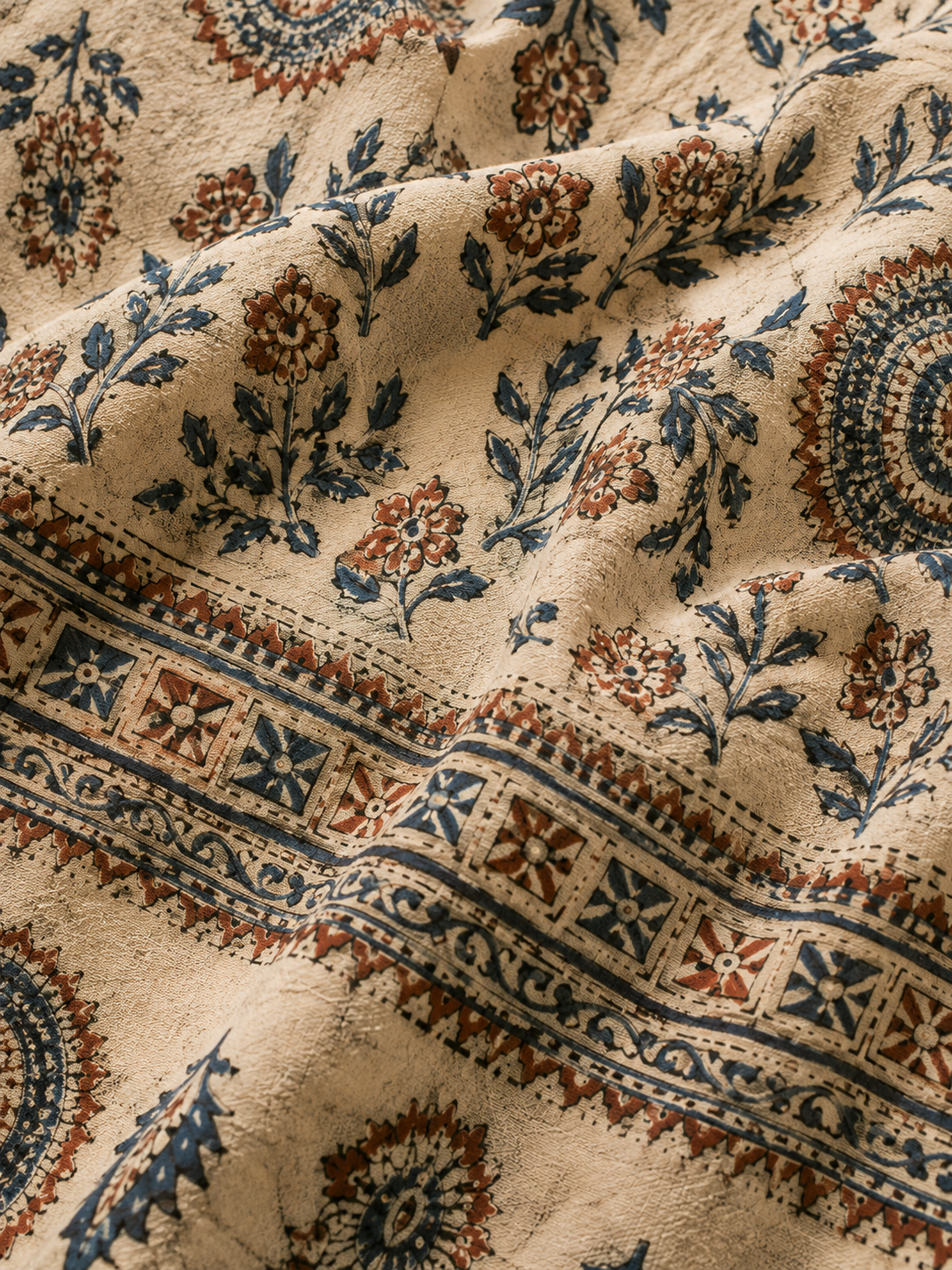
A genuine Bagru saree owes its distinctive soft, slightly faded look to something unglamorous and specific: fermented mud, used as a dye-resist before printing. It’s a detail that sounds minor until you realize it’s the entire reason the fabric looks the way it does — and why no chemical shortcut fully replicates it.
01 — Origin
Where Bagru comes from
Bagru printing takes its name from the town of Bagru in Rajasthan, near Jaipur, where the technique has been practiced for generations, historically by the Chhipa community of block printers. The tradition sits within the same broader family of natural-dye hand-block printing as Ajrakh, though the two developed with distinct techniques, motifs, and colour palettes in their respective regions.
02 — How it’s made
Bagru print: made with mud, dyed with earth
The defining step in Bagru’s process is the use of a fermented mud paste — often called “dabu” — applied via carved wooden blocks to areas of the fabric that should resist the dye. When the fabric is then dyed, the mud-covered sections stay undyed, creating the pattern. Natural dyes drawn from indigo, madder root, and turmeric provide the finished colour palette, layered across multiple printing and dyeing passes similar in spirit to Ajrakh, though with Bagru’s own distinct motifs and mud-specific process.
The mud itself is what gives genuine Bagru its characteristic soft, slightly irregular edge — a look that chemical resist methods or screen-printing simply produce differently, since they don’t rely on an organic material with its own natural variation.
The irregularity is the point
Because mud doesn’t spread with perfect precision the way a chemical resist can, genuine Bagru has a soft, slightly uneven quality at pattern edges — this isn’t a flaw or inconsistency to worry about, it’s a direct signature of the process and one of the clearest ways to identify authentic work.
03 — How to tell it’s genuine
What to check
- Look for soft, slightly irregular pattern edges. Genuine mud-resist printing produces gently uneven boundaries, not crisp mechanical lines — a Bagru print with laser-sharp edges is likely a screen-printed imitation.
- Check the colour palette. Traditional Bagru favours earthy, muted tones from natural dyes — bright, uniform, highly saturated colours are more consistent with synthetic dyeing.
- Feel the fabric. Bagru is typically printed on lightweight cotton with a soft hand — a stiffer or synthetic-feeling base fabric is a signal to look closer.
- Expect some initial colour bleed. As with other natural-dye block prints, a genuine piece often needs a couple of gentle washes before the colour is fully set.
04 — What it costs
A rough price guide
| Type | What it means | Typical price |
|---|---|---|
| Screen-printed “Bagru style” | Machine-printed imitation, no mud-resist step | ₹700 – 1,800 |
| Hand-block Bagru, natural dye, simpler design | Genuine mud-resist process, standard motifs | ₹2,500 – 6,000 |
| Fine multi-colour Bagru, dense patterning | Multiple dye passes, intricate motif combinations | ₹7,000 – 15,000+ |
05 — Wearing and caring for it
Once you own one
Bagru’s earthy palette and lightweight cotton base make it an easy, versatile everyday piece — comfortable in warm weather and understated enough to pair with almost any blouse or jewellery style. It reads as effortlessly put-together rather than formal, which makes it a good fit for daily wear or casual gatherings.
Care follows the same natural-dye principles as Ajrakh: wash separately in cold water for the first few washes, line-dry in shade to protect the colour, and iron on the reverse side while slightly damp for the best finish.
06 — Common questions
Quick answers
What’s the difference between Bagru and Ajrakh?
Both are natural-dye hand-block printing traditions from neighbouring regions, but they use different resist techniques and produce distinct motifs and colour palettes — Bagru’s mud-resist (“dabu”) process and softer, earthier look sets it apart from Ajrakh’s more geometric, indigo-forward style.
Why does the mud matter if it just resists dye?
The organic, slightly irregular way fermented mud spreads on fabric is what gives genuine Bagru its distinctive soft-edged look — a purely mechanical or chemical resist produces a visibly different, more uniform result.
Is Bagru affordable compared to other block prints?
Generally yes — simpler genuine Bagru pieces sit at a comparable or slightly lower price point than Ajrakh, though intricate multi-colour work can reach similar prices to fine Ajrakh pieces.
Looking for genuine Bagru?
We post mud-resist block-printed pieces in the WhatsApp circle as they arrive from Rajasthan — real earth, real dye, no shortcuts.