HANDLOOM SAREES · UNSTITCHED SUIT MATERIALS · SOURCED DIRECTLY FROM WEAVERS · FREE SHIPPING ACROSS INDIA

Kantha Saree Guide: Hand-Stitched Bengal Embroidery

Weave Spotlight · The Craft
Kantha saree:
old cloth,
made new again.
A Kantha saree isn’t woven with a special technique — it’s quilted from layers of old cloth into something new. Here’s the original slow fashion, explained.
6-minute read · Weave Spotlight
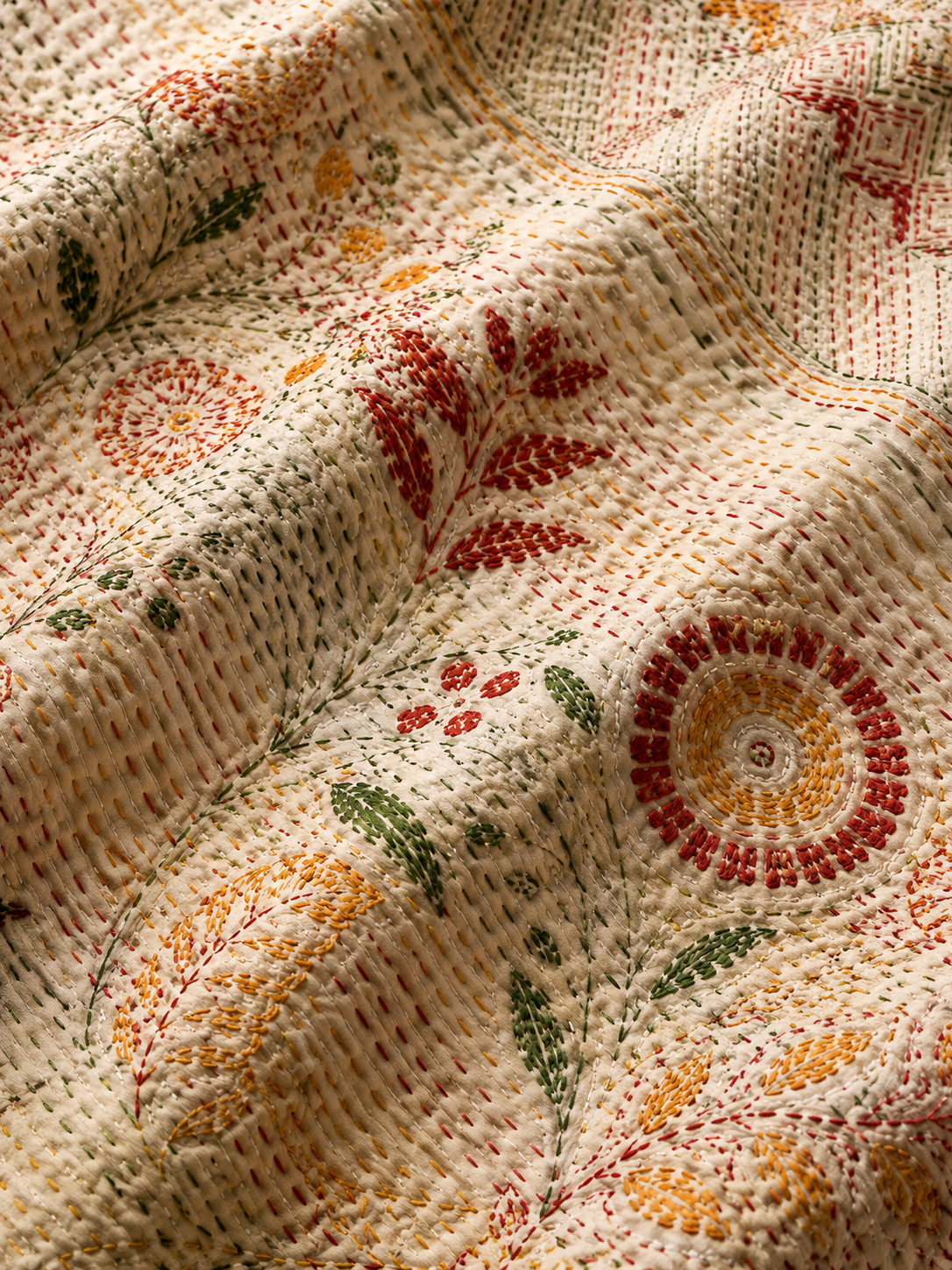
A Kantha saree starts, unusually, with fabric that already exists — old sarees, worn soft with age, layered together and stitched into something entirely new. It’s not a weave at all, but a needlework tradition, and one of the earliest examples of what we’d now call sustainable fashion.
01 — Origin
Where Kantha comes from
Kantha originates in West Bengal and neighbouring Bangladesh, where the tradition of quilting old cloth with running-stitch embroidery goes back centuries, historically practiced by women at home rather than in a formal workshop setting. Old, softened sarees and dhotis were layered together and stitched with simple running stitches — partly for warmth and practicality, and partly as a form of storytelling, with motifs often drawn from daily life, nature, and folklore.
02 — How it’s made
Not woven — quilted
Unlike every other saree on this list, a Kantha saree’s character comes from embroidery and layering, not from how the base fabric is woven. Several layers of old, soft cotton or silk fabric are stacked together, then stitched through all layers with a simple running stitch — the same stitch repeated thousands of times to build up the pattern, texture, and structure of the final piece.
The stitching itself creates a subtle rippled, textured surface as the layers pull slightly with each pass of the needle — this texture is part of what makes genuine Kantha immediately recognizable by touch, not just by sight.
A tradition rooted in reuse
Kantha’s origin as a way to give old, worn fabric new life makes it one of the more genuinely sustainable handloom traditions — long before “recycled fashion” was a marketing term, Kantha was built entirely around reusing what already existed rather than starting from new cloth.
03 — How to tell it’s genuine
What to check
- Feel for the layering. Genuine Kantha has a soft, slightly padded feel from multiple stitched-together layers — a single-layer fabric with printed embroidery-style patterns is not real Kantha.
- Look for stitch irregularity. Hand-run stitches vary subtly in length and spacing across the piece. Machine embroidery mimicking Kantha is far more uniform and precise.
- Check both sides. Genuine hand-stitched Kantha shows the running stitch pattern on the reverse too, since the needle passes fully through all the fabric layers.
- Consider the softness. Because it’s made from reused, already-softened fabric, authentic Kantha tends to feel notably soft even when new — a stiff “Kantha” saree is a signal to look closer.
04 — What it costs
A rough price guide
| Type | What it means | Typical price |
|---|---|---|
| Machine-embroidered imitation | Single layer, machine-stitched pattern | ₹1,500 – 3,500 |
| Hand-stitched Kantha, simple motifs | Genuine layered quilting, lighter stitch density | ₹4,000 – 9,000 |
| Fine hand-stitched Kantha, dense narrative motifs | Detailed storytelling patterns, master craftspeople | ₹10,000 – 25,000+ |
05 — Wearing and caring for it
Once you own one
Kantha’s soft, lived-in quality means it wears comfortably from the very first time — there’s no stiff break-in period the way there is with dense silks. It suits relaxed, everyday settings well, though finer Kantha with elaborate narrative embroidery can hold its own for more dressed-up occasions too.
Care is straightforward compared to delicate silks: hand-wash separately in cold water given the embroidery, and iron on low heat. Because the fabric is inherently a composite of layers, avoid harsh wringing that could strain the stitching over time.
06 — Common questions
Quick answers
Is Kantha a weave or an embroidery style?
Embroidery and quilting — Kantha involves stitching, not weaving. The base fabric is typically already-woven cotton or silk, layered and then hand-stitched.
Why is Kantha considered sustainable?
Traditionally, Kantha was made from reused old fabric rather than new cloth — a recycling-based craft tradition that predates modern sustainable fashion movements by generations.
Does every Kantha piece use old fabric?
Traditionally yes, though many pieces made today use new base fabric with the same hand-stitched quilting technique applied — the stitching tradition itself, not necessarily the reused-fabric origin, is what’s usually being referenced today.
Looking for a Kantha saree?
We post genuine hand-stitched pieces in the WhatsApp circle as they arrive from Bengal artisans.