HANDLOOM SAREES · UNSTITCHED SUIT MATERIALS · SOURCED DIRECTLY FROM WEAVERS · FREE SHIPPING ACROSS INDIA

Bhujodi Saree: Handwoven Cotton from Kutch

Weave Spotlight · The Craft
Bhujodi saree:
cotton from Kutch.
The Bhujodi saree is handwoven on pit looms in Kutch, Gujarat, in earthy cotton with designs woven in by the Vankar weavers. Origin, how to spot a real one, and what it should cost.
6-minute read · Weave Spotlight
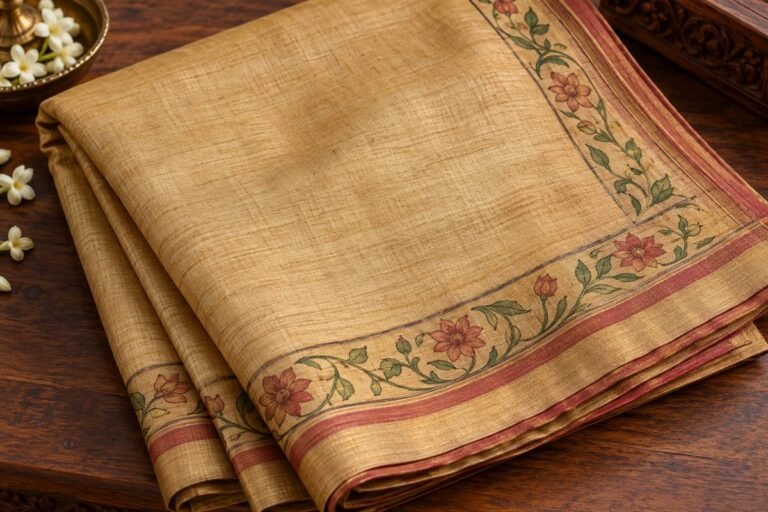
A Bhujodi saree comes from a single village in Kutch, where weavers have worked wool and cotton for generations. It is among the most honest of handlooms: textured, durable, and made for daily life. Here is how to recognise a real Bhujodi saree.
01 — Origin
Where does a Bhujodi saree come from?
Bhujodi is a village a few kilometres from Bhuj in Kutch, Gujarat, and it has been a weaving centre for generations. The weavers belong to the Vankar community, who traditionally wove wool and cotton for the region’s herders and farmers. A Bhujodi saree is the same craft turned to the six-yard length: handwoven, earthy, and made to be worn every day.
02 — What makes it different
Pit looms, and designs woven in
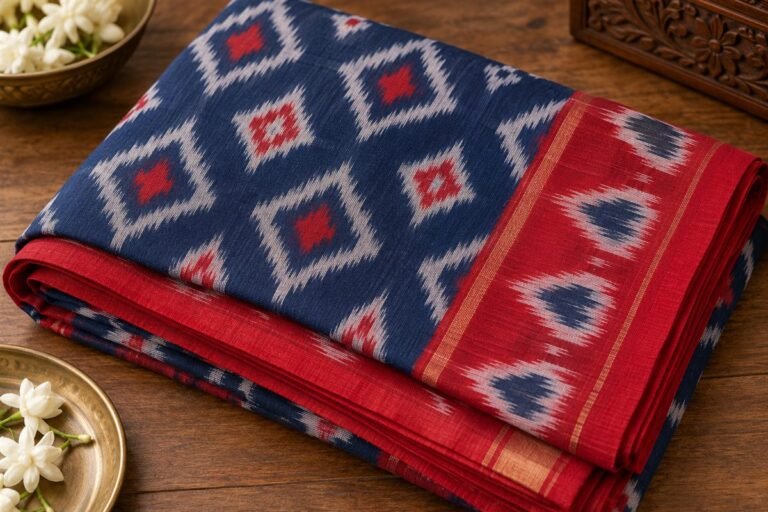
Bhujodi weaving is done on pit looms, where the weaver sits with feet in a pit working the treadles. The patterns are made with an extra, supplementary weft: additional threads are woven in only where the motif is needed, which gives the small geometric designs on the border and pallu a slightly raised, textured look. These are built into the cloth, not printed on it.
The yarn is often hand-spun or locally sourced, including the soft desi cotton of Kutch, and colours are frequently natural: indigo blues, madder reds, and undyed creams and browns. The result is a fabric with a visible, pleasant slub and a lot of character.
03 — Wearing it
A saree for every day
A Bhujodi saree is cotton or a cotton-silk blend, so it is breathable and easy in a warm climate. It has a natural crispness that holds pleats well, which makes it a good first handloom saree and a strong choice for work. It pairs well with a simple blouse, silver or oxidised jewellery, and flat footwear. Our guide to wearing a saree to work shows how well a structured cotton holds through a long day.
Textured, not flawed
A slub, a slight irregularity in the thread, or a small variation in the colour of a natural dye is part of what Bhujodi weaving looks like. A perfectly uniform finish is more likely powerloom.
04 — How to tell it is genuine
Three checks and a price range
Look at the motifs on the reverse, where a genuine supplementary weft shows its floating threads, while a print shows nothing. Feel the cloth: it should be firm and slightly textured, not slick. And read the price. As a rough guide, a handloom cotton Bhujodi saree is likely to fall somewhere from about ₹3,000 to ₹10,000, with finer or silk-blend pieces costing more. A “Bhujodi-style” saree at a few hundred rupees is almost certainly powerloom. Our handloom saree price guide and our guide to real handloom versus fake explain how to read these signals. If you like handwoven cotton, our guides to Kantha and Mangalgiri are good next reads.
05 — Care
Keeping it fresh
Wash a Bhujodi saree separately and gently in cold water with a mild detergent, because natural dyes can bleed in the first washes. Dry it in the shade, and press it on a medium setting from the reverse. Fold it loosely, and it will soften with age.
06 — Common questions
Quick answers
What is a Bhujodi saree?
A handwoven cotton or cotton-silk saree from Bhujodi village in Kutch, Gujarat, woven on pit looms with supplementary-weft designs.
Is a Bhujodi saree handloom?
A genuine one is. It is woven by hand on a pit loom. Powerloom copies exist, so check the reverse and the price.
How much does a Bhujodi saree cost?
Roughly ₹3,000 to ₹10,000 for handloom cotton, and more for fine or silk-blend pieces. These are rough ranges, not a price list.
Is a Bhujodi saree good for daily wear?
Yes. It is breathable, holds pleats, and wears well, which is why it suits work and everyday use.
Looking for a Bhujodi?
Tell us what you are looking for over WhatsApp and we will tell you honestly what is available in handwoven cotton.