HANDLOOM SAREES · UNSTITCHED SUIT MATERIALS · SOURCED DIRECTLY FROM WEAVERS · FREE SHIPPING ACROSS INDIA

Jamdani Saree Guide: The Weave Woven Like Air

Weave Spotlight · The Craft
Jamdani saree:
fabric woven
like air.
The most labour-intensive handloom weave in the world, explained — how it’s made without a single machine, what it should cost, and how to spot a real one.
7-minute read · Weave Spotlight
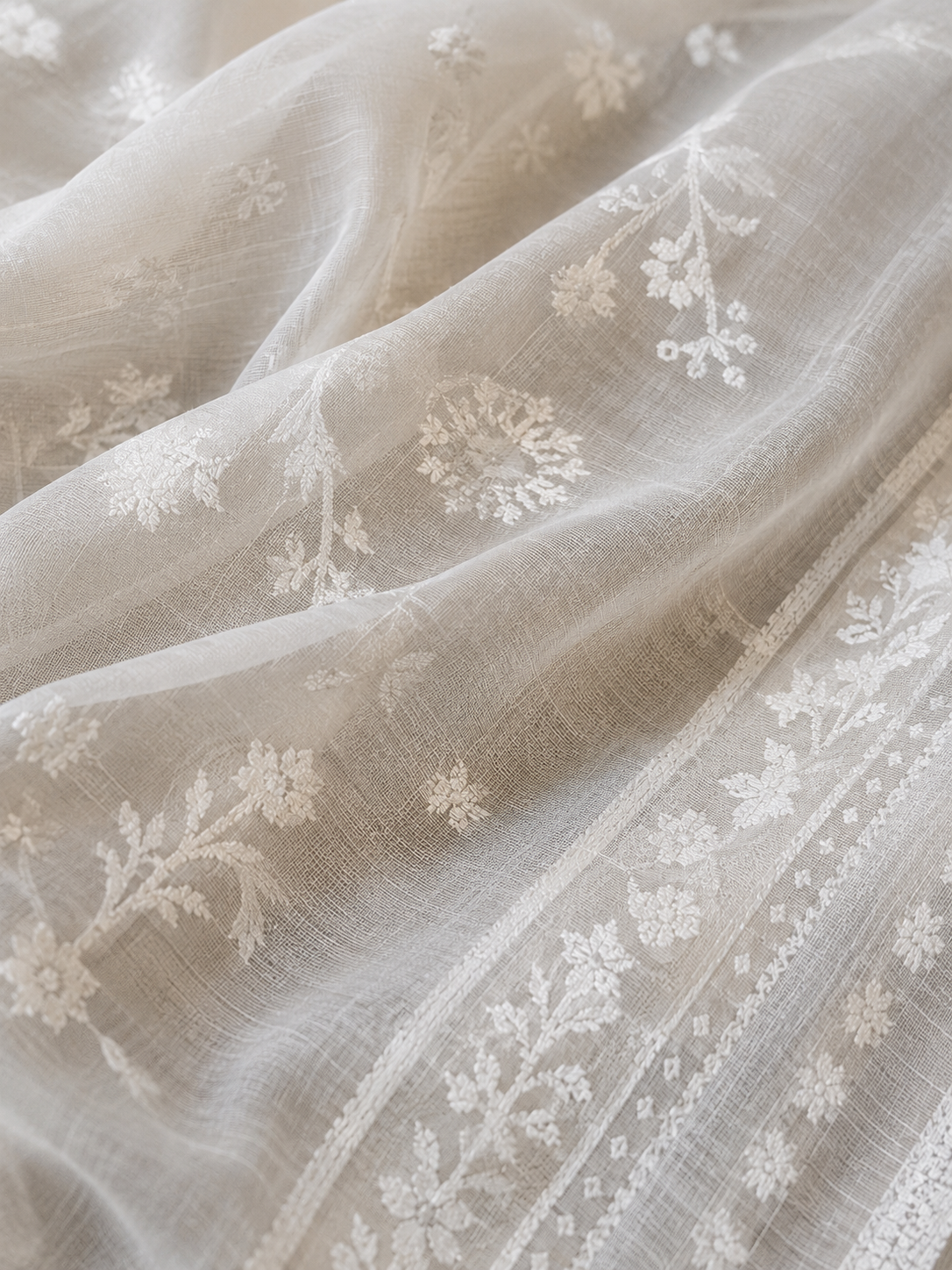
A genuine Jamdani saree is woven, not printed or embroidered — every single motif is built into the fabric by hand, thread by thread, as the saree is being made. There is no faster way to do it. That’s exactly why it’s rare, and exactly why it’s worth understanding before you buy one.
01 — Origin
Where the Jamdani comes from
Jamdani originates in Bengal — largely the districts around Dhaka (now in Bangladesh) and parts of West Bengal on the Indian side. Its history traces back over a thousand years, with fine muslin fabrics from this region once so prized they were traded across the Mughal empire and reportedly reached European courts.
In 2013, UNESCO recognized traditional Jamdani weaving as an Intangible Cultural Heritage of Humanity — a formal acknowledgment of a technique that has survived almost unchanged despite centuries of mechanization elsewhere in textiles.
02 — How it’s made
Woven, not embroidered
Jamdani’s defining feature is its supplementary weft technique: while the base fabric (usually fine cotton or cotton-silk blend) is being woven, the weaver adds extra threads by hand at each point a motif appears, working the pattern directly into the structure of the cloth. This is fundamentally different from embroidery, which is added onto a finished fabric afterward — a Jamdani motif is part of the weave, not applied on top of it.
This means every Jamdani saree requires the weaver to essentially reconstruct the pattern by memory or a paper guide underneath the loom, motif by motif, for the entire length of the saree. There’s no mechanical shortcut for this — it’s one of the reasons Jamdani has never been successfully replicated on a powerloom the way Benarasi or Kanjivaram sometimes are.
What “imitations” actually look like
Since true Jamdani can’t easily be faked on a powerloom, the more common imitation is printed cotton with Jamdani-style motifs stamped or screen-printed on — visually similar from a distance, but the pattern sits flat on the surface rather than being woven through the fabric, and it won’t show on the reverse side the way genuine work does.
03 — How to tell it’s genuine
Four things to check
- Check the reverse side. On a real Jamdani, the motifs are visible on the back too — slightly duller than the front, but clearly the same pattern woven through. Printed imitations show little to nothing on the reverse.
- Feel the fabric where a motif sits. Genuine woven motifs have a very slight raised texture where the extra weft thread was added — printed patterns feel completely flat.
- Look for tiny irregularities between repeats. Since every motif is placed by hand, no two repeats are perfectly identical. Printed patterns repeat with mechanical precision.
- Consider the fabric weight and translucency. Authentic Jamdani, especially fine varieties, is famously lightweight and almost sheer — a heavier, opaque cotton claiming to be Jamdani is worth questioning.
04 — What it costs
A rough price guide
| Type | What it means | Typical price |
|---|---|---|
| Printed cotton, Jamdani-style motifs | Machine-printed pattern on plain cotton | ₹1,000 – 3,000 |
| Simple handloom Jamdani, sparse motifs | Genuine weave, lighter motif density | ₹4,000 – 9,000 |
| Fine Jamdani, dense motif work | Intricate all-over patterning, silk-cotton blend options | ₹10,000 – 25,000 |
| Master-weaver / heirloom-grade Dhakai Jamdani | Exceptional density and fineness, rare motifs | ₹30,000+ |
05 — Wearing and caring for it
Once you own one
Jamdani’s lightness makes it a natural choice for warm-weather occasions and daytime events where a heavy silk would feel like too much. It drapes softly and doesn’t hold structure the way a stiffer silk does, so it pairs well with simpler jewellery that doesn’t compete with the fine motif work.
It’s also more fragile than heavier weaves — hand-wash cold, never wring, and iron on the reverse while still slightly damp. Because the extra weft threads that form each motif can snag more easily than a plain weave, handle it gently, especially around jewellery and rough surfaces. Our full care guide covers this fabric-by-fabric if you want the complete routine.
06 — Common questions
Quick answers
Is Jamdani the same as muslin?
Not quite — muslin refers to the extremely fine base cotton fabric, which Jamdani is traditionally woven from. Jamdani specifically refers to the technique of weaving motifs into that base fabric, not the fabric itself.
Can Jamdani be made in silk?
Yes — while cotton is traditional, silk and silk-cotton blend Jamdani sarees exist and are generally priced higher due to the raw material cost, though the weaving technique remains the same.
Why is Jamdani so much more expensive than plain cotton handloom?
The motif work is entirely manual and dramatically slows down weaving — a saree with dense Jamdani patterning can take weeks longer than a plain-weave cotton handloom saree of the same base fabric.
Looking for a real Jamdani?
We post genuine hand-woven pieces in the WhatsApp circle as they arrive from Bengal — no restocks, no printed imitations.