HANDLOOM SAREES · UNSTITCHED SUIT MATERIALS · SOURCED DIRECTLY FROM WEAVERS · FREE SHIPPING ACROSS INDIA

Kalamkari Saree: Painted by Hand, Steeped in Story

Weave Spotlight · The Craft
Kalamkari saree:
painted by hand,
steeped in story.
A hand-painted and block-printed textile tradition from Andhra Pradesh — natural dyes, mythological motifs, and how to tell which of the two surviving schools made yours.
7-minute read · Weave Spotlight
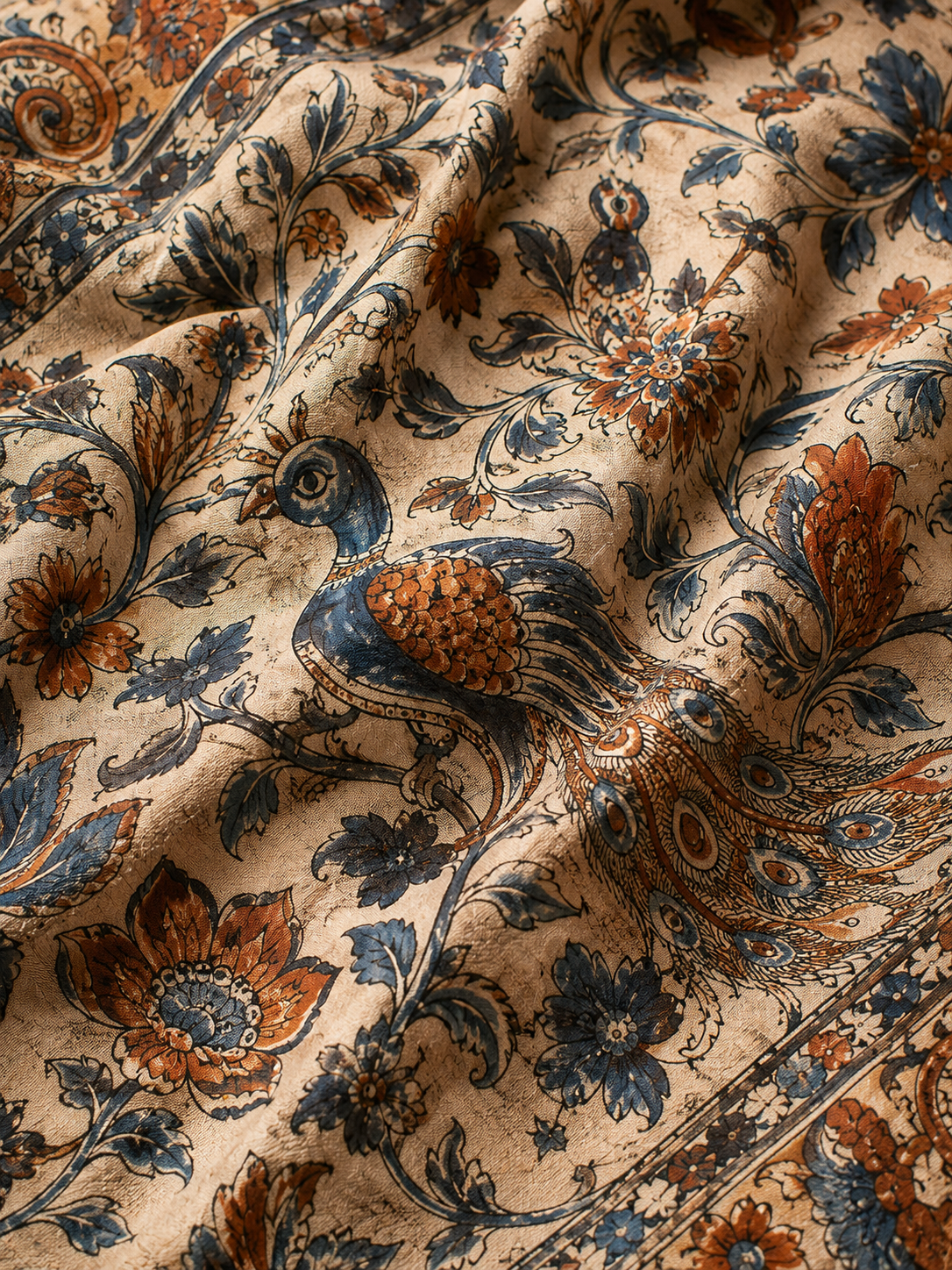
A Kalamkari saree isn’t woven at all — it’s drawn or printed onto handloom cotton using nothing but natural dyes, in a craft that survives today in exactly two towns of Andhra Pradesh. Here’s what separates a genuine piece from the screen-printed “Kalamkari-style” version sold everywhere online.
01 — Origin
Where does a Kalamkari saree come from?
Kalamkari takes its name from the Persian “qalam” (pen) and “kari” (work) — a legacy of the craft’s long trade history with Persia and, later, Europe, under the Golconda Sultanate. Temples in Srikalahasti commissioned large painted cloths depicting mythological scenes for their walls and processions, while the port town of Machilipatnam developed block-printing to produce cloth at scale for export. Both traditions are still practised today, largely by the same families that have done it for generations.
02 — What makes it different
Two schools, one hand
Srikalahasti Kalamkari is entirely freehand — an artisan draws directly onto the cloth with a bamboo or date-palm pen dipped in a fermented dye, building up mythological narratives (scenes from the Ramayana and Mahabharata are common) panel by panel. No two pieces are ever quite identical.
Machilipatnam Kalamkari uses hand-carved wooden blocks to print motifs — usually florals, paisleys, and geometric borders — in repeatable but still entirely hand-done passes. It’s more production-scalable than pen-work, but every colour is still a separate manual printing step using natural dyes: indigo for blue, madder root for red, pomegranate rind and myrobalan for yellow, and a jaggery-and-iron-filings ferment for the deep black outlines.
Why it smells faintly earthy before the first wash
Before any dye touches the cloth, Kalamkari fabric is treated in a mix of buffalo milk and myrobalan (a fruit extract) — a step that helps the natural dyes bond and stay colourfast. It leaves a faint, distinctly natural smell that fades after the first couple of washes. Synthetic, screen-printed imitations skip this step entirely, so a completely “clean,” odourless piece is worth a second look.
03 — How to tell it’s genuine
What to check
Here’s how to spot a genuine Kalamkari saree before you buy:
- Look for hand variation. On pen-Kalamkari, no two motifs are perfectly identical — a repeat pattern that’s pixel-for-pixel the same is a screen print, not hand work.
- Check the palette. Genuine natural dyes read as earthy and slightly muted — deep maroons, mustard yellows, indigo blues — rather than the flat, saturated brightness of synthetic dye.
- Ask which school made it. A seller who can tell you Srikalahasti (pen) or Machilipatnam (block) — and show the difference — is usually sourcing genuinely.
- Be wary of very low prices. The 20-plus-step natural dyeing process puts a real cost floor under authentic Kalamkari; anything priced like a plain cotton print is almost certainly a synthetic imitation.
04 — What it costs
A rough price guide
What should a genuine Kalamkari saree cost? Here’s a rough guide:
| Type | What it means | Typical price |
|---|---|---|
| Synthetic, screen-printed “Kalamkari-style” | Machine print imitating the look, no natural dye | ₹800 – 2,000 |
| Machilipatnam, hand block-printed, natural dye | Traditional block printing, repeatable motifs | ₹3,000 – 8,000 |
| Srikalahasti, hand-painted, narrative panels | Freehand pen-work, mythological scenes | ₹8,000 – 30,000+ |
05 — Wearing and caring for it
Once you own one
Kalamkari’s earthy, storytelling motifs sit somewhere between casual and formal — block-printed pieces work well as everyday or daytime wear, while an elaborate hand-painted narrative piece is usually kept for occasions where it can be properly seen and appreciated.
Some initial dye release in the first two to three washes is normal with natural dyes and isn’t a defect — it’s the colour finishing its set. Hand-wash separately in cold water for those first few washes, avoid wringing, dry away from direct sunlight to prevent fading, and iron on the reverse on low heat to protect the painted or printed surface.
06 — Common questions
Quick answers
Is a Kalamkari saree a weave or a print?
Neither, technically — it’s a hand-painting or block-printing technique applied onto woven cotton (occasionally silk). The base fabric can be handloom or mill-woven, so if you specifically want a handloom base with Kalamkari work, ask the seller directly.
What’s the real difference between Srikalahasti and Machilipatnam Kalamkari?
Srikalahasti is freehand pen-drawn, usually mythological or narrative scenes, and more rare and expensive. Machilipatnam is hand block-printed, usually floral or geometric motifs, and more production-scalable while still entirely hand-done with natural dyes.
Does the colour run?
Some dye release in the first two to three washes is expected and normal with natural dyes — not a flaw. Wash separately in cold water until the colour stabilises.
Can Kalamkari be worn daily?
Everyday block-printed cotton Kalamkari is practical for regular wear. The more elaborate hand-painted narrative pieces are typically reserved for occasions, given their rarity and cost.
See also: find out what a real Kalamkari should cost in our handloom saree price guide and which blouse designs suit handloom sarees.
Related reading
Also: Is Kalamkari handloom?.
Looking for a Kalamkari saree?
We post genuine hand-painted and block-printed Kalamkari pieces in the WhatsApp circle as they arrive — natural dyes, real provenance, both schools.