HANDLOOM SAREES · UNSTITCHED SUIT MATERIALS · SOURCED DIRECTLY FROM WEAVERS · FREE SHIPPING ACROSS INDIA

Ajrakh Print Guide: Natural Dye Block Printing

Weave Spotlight · The Craft
Ajrakh print:
16 steps,
zero shortcuts.
A natural-dye block-printing tradition from Kachchh — indigo, madder, and pomegranate, applied by hand, one careful pass at a time.
6-minute read · Weave Spotlight
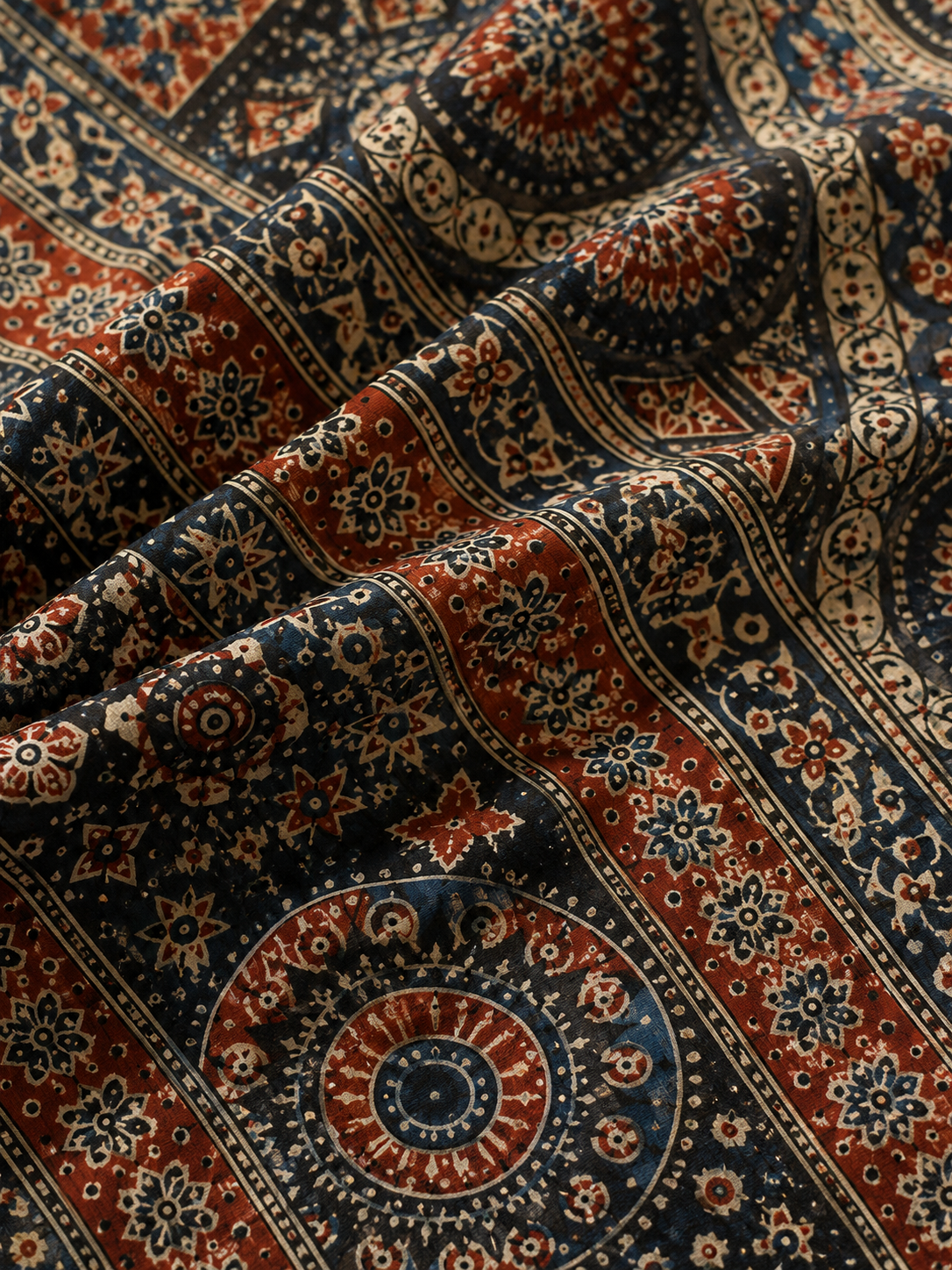
Ajrakh isn’t a weave — it’s a printing tradition, and one of the most demanding ones in India. A single piece passes through roughly sixteen separate stages of washing, dyeing, and printing before it’s finished, each one done entirely by hand using natural dyes that have barely changed in method for generations.
01 — Origin
Where Ajrakh comes from
Ajrakh printing is centered in Kachchh, Gujarat, historically practiced by the Khatri community — most famously the family workshop of the late Dr. Ismail Khatri, widely credited with preserving and reviving the traditional natural-dye process at a time when synthetic alternatives were replacing it elsewhere. The technique also has roots stretching into Sindh (in present-day Pakistan), reflecting the shared cultural history of the region before Partition.
02 — How it’s made
The 16-step process
Ajrakh’s defining feature is that it’s entirely natural-dye, block-printed by hand — no screen-printing, no chemical shortcuts. The process typically layers indigo, madder root, and pomegranate rind across multiple printing and dyeing passes, with the fabric washed and dried between most steps. Each colour requires its own carved wooden block and its own printing pass, which is why complex Ajrakh pieces with several colours take considerably longer than simpler ones.
The name itself is thought to derive from “Azrak,” the Arabic/Persian word for blue — indigo remains the tradition’s signature colour, though the finished palette typically includes deep reds, blacks, and off-whites as well.
A geometric signature
Ajrakh’s motifs are almost always geometric — stars, trellises, and repeating symmetrical patterns — rather than figurative designs. This geometric quality, combined with the muted depth of natural dyes, makes genuine Ajrakh visually distinct from more decorative printed textiles even before you check the technical details.
03 — How to tell it’s genuine
What to check
- Check if the print bleeds through to the reverse. Genuine hand-block printing with natural dyes typically shows the pattern faintly on the back of lighter cottons, since the dye penetrates the fabric rather than sitting only on the surface. Machine screen-printing usually stays crisp on the front and shows little on the back.
- Look at colour depth, not just colour. Natural indigo and madder have a slightly muted, layered depth compared to the flatter, more uniform tone of synthetic dyes.
- Expect some initial colour bleed. Natural-dye pieces typically need 2–3 separate washes before the colour fully sets — a seller who tells you this upfront is a good sign, not a red flag.
- Check for slight block-edge irregularity. Hand-stamped blocks leave tiny inconsistencies at pattern edges from one repeat to the next — perfectly uniform edges suggest a printed or digital reproduction instead.
04 — What it costs
A rough price guide
| Type | What it means | Typical price |
|---|---|---|
| Synthetic screen-print, “Ajrakh style” | Machine-printed imitation, chemical dyes | ₹800 – 2,000 |
| Hand-block print, natural dye, simpler patterns | Genuine process, fewer colour passes | ₹3,500 – 8,000 |
| Master workshop, multi-colour, fine detail | Full 16-step process, complex layered motifs | ₹10,000 – 20,000+ |
05 — Wearing and caring for it
Once you own one
Ajrakh’s earthy, geometric palette works well for both casual and semi-formal settings, and the lightweight cotton base makes it genuinely comfortable in warm weather. Given the natural dye process, first-wash care matters more than usual: wash separately in cold water for the first 2–3 washes to let the colour settle, then line-dry in shade to prevent fading.
Iron on the reverse side while the fabric is still slightly damp — this actually helps revive the print’s depth rather than risking damage, unlike delicate silks that need a gentler approach.
06 — Common questions
Quick answers
Is Ajrakh a weave or a print?
A print — Ajrakh refers specifically to the hand-block printing and natural dyeing process applied to plain woven cotton or silk, not a weaving technique itself.
Why does the colour bleed in the first few washes?
Natural dyes need a few wash cycles to fully bind and stabilize on the fabric — this is normal and expected, not a defect, and settles down after the first 2–3 washes.
Is Ajrakh always blue?
Indigo blue is the signature colour, but finished pieces typically combine it with deep reds (from madder), black, and off-white in the same design — rarely a single solid colour throughout.
Looking for genuine Ajrakh?
We post natural-dye block-printed pieces in the WhatsApp circle as they arrive from Kachchh — no shortcuts, no screen prints.