HANDLOOM SAREES · UNSTITCHED SUIT MATERIALS · SOURCED DIRECTLY FROM WEAVERS · FREE SHIPPING ACROSS INDIA

Patola Saree Guide: The World’s Hardest Handloom Weave

Weave Spotlight · The Craft
Patola saree:
the hardest weave
on Earth.
Double-ikat silk from three families in Patan, Gujarat — what makes it the most technically demanding handloom weave in the world, and why it takes six months.
7-minute read · Weave Spotlight
There are only a handful of families left in the world who weave authentic Patola. Not because the tradition is dying out from lack of demand, but because the technique itself takes decades to master and months to execute on every single piece. Here’s what actually makes it so difficult, and what to know before you consider one.
01 — Origin
Where the Patola comes from
Patola silk comes from Patan, a city in Gujarat with a weaving tradition dating back roughly 900 years, tied historically to trade with Southeast Asia — Patola sarees were once exported as far as Indonesia, where they became treasured heirloom textiles in their own right. Today, authentic Patan Patola is woven almost exclusively by members of the Salvi community, historically down to just three families continuing the craft at the highest level.
02 — How it’s made
What double-ikat actually means
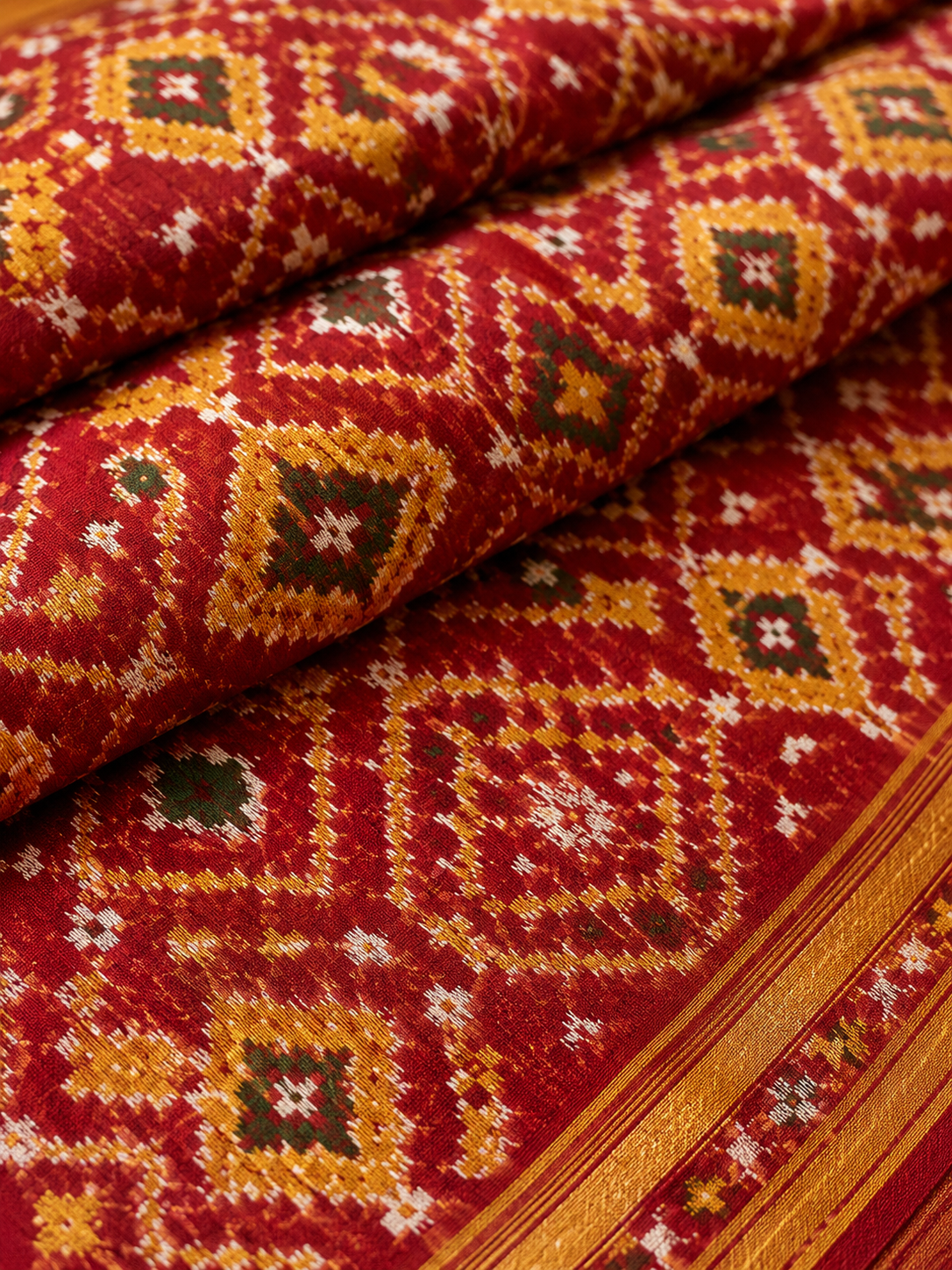
Most tie-dye or ikat techniques dye either the vertical threads (warp) or the horizontal threads (weft) before weaving. Patola does both — every single warp and weft thread is individually measured, tied, and dyed in the exact pattern before weaving even begins. The weaver then has to align both sets of pre-dyed threads with painstaking precision on the loom so the pattern emerges correctly as they weave — a margin of error measured in millimetres, repeated across the entire six-yard length.
This is why the pattern on a genuine Patola appears identical on both the front and back of the fabric — there’s no “right side,” because the color is fully integrated into the thread itself before weaving, not applied afterward. That single detail is the fastest way to identify a real one.
Why it takes so long
A single Patola saree can take up to 6 months to complete, factoring in the measuring, tying, and dyeing of every thread before a single pass of the loom. Compare that to a Benarasi (15 days to 2 months) or even a Kanjivaram — Patola’s pre-weaving preparation alone often takes longer than most other sarees take start to finish.
03 — How to tell it’s genuine
What to check
- Compare front and back. This is the single most reliable test — genuine double-ikat Patola looks essentially the same on both sides. If one side is noticeably duller, cleaner, or different from the other, it isn’t true double-ikat.
- Understand what you’re actually buying. “Rajkot Patola” is single-ikat (only the weft is dyed), made faster and sold at a much lower price point — legitimate in its own right, but a fundamentally different (and far less labour-intensive) product than Patan double-ikat. Sellers should be transparent about which one you’re getting.
- Check for slight softness in the pattern edges. Because the dyed threads are aligned by hand rather than mechanically, pattern edges in genuine Patola have a very subtle softness rather than laser-sharp precision — a printed or powerloom imitation shows harder, more uniform pattern edges.
- Ask about provenance. Given how few weavers produce authentic Patan Patola, a seller who can speak specifically to which family or workshop a piece came from is a meaningfully different signal than a generic product listing.
04 — What it costs
A rough price guide
| Type | What it means | Typical price |
|---|---|---|
| Printed/powerloom “Patola print” | Machine-printed pattern imitating the look | ₹2,000 – 6,000 |
| Rajkot Patola (single-ikat) | Genuine handloom, only weft is dyed — faster, more affordable | ₹15,000 – 40,000 |
| Patan Patola (true double-ikat) | Full traditional technique, months of preparation | ₹2,00,000 – 8,00,000+ |
This is a genuinely wide gap, and it exists for a real reason — the labour difference between single- and double-ikat isn’t marginal, it’s an order of magnitude.
05 — Wearing and caring for it
Once you own one
Given the price and rarity, a Patan Patola is typically treated as an investment or heirloom piece rather than everyday wear — many families pass a single Patola down across generations rather than buying multiple. Dry-clean only, store flat wrapped in muslin away from light, and handle with particular care given how much work is represented in the fabric.
06 — Common questions
Quick answers
What’s the difference between Patola and Rajkot Patola?
Patan Patola uses double-ikat (both warp and weft dyed before weaving); Rajkot Patola uses single-ikat (only the weft). Both are genuine handloom techniques, but Patan Patola is far more labour-intensive and expensive.
Why are there so few authentic Patola weavers left?
The technique traditionally passes within specific families and takes years to master, combined with the sheer time investment per piece limiting how many can be produced — this has kept the circle of true master weavers very small.
Is Patola always silk?
Traditional Patan Patola is woven in pure silk. Cotton ikat exists as a separate, different craft tradition and shouldn’t be confused with silk Patola.
Curious about a genuine Patola?
Authentic Patan double-ikat is rare and often made to order — write to us and we’ll check current availability from the weaver families we work with.