HANDLOOM SAREES · UNSTITCHED SUIT MATERIALS · SOURCED DIRECTLY FROM WEAVERS · FREE SHIPPING ACROSS INDIA

Is Kalamkari Handloom? The Honest Answer

Weave Spotlight · Quick Answer
Is Kalamkari handloom?
Is Kalamkari handloom? A short, honest answer on what Kalamkari is, when the cloth counts as handloom, and how to check before you buy.
4-minute read · Weave Spotlight
It is one of the most common questions we get about this craft: is Kalamkari handloom? The answer depends on what you mean by handloom, and on which part of the saree you are asking about.
01 — The short answer
Is Kalamkari handloom? It depends on the cloth
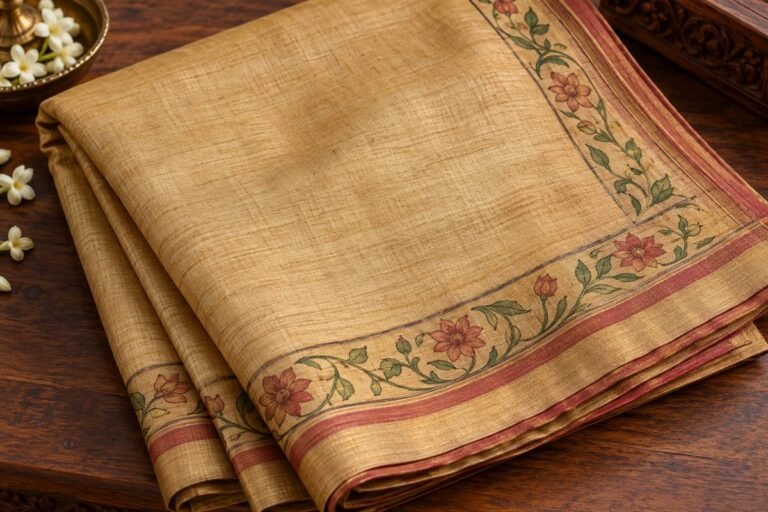
Kalamkari is not a weave at all. It is a way of putting colour on cloth, either by drawing freehand with a pen or by printing with carved wooden blocks, using natural dyes. So when people ask whether Kalamkari is handloom, the honest answer is that the Kalamkari work itself is handmade, but whether the cloth underneath is handloom depends on who made it. The base can be handwoven cotton or silk, or it can be mill-made.
02 — Craft versus cloth
Two different things to ask about
It helps to separate two questions. First: is the design hand-painted or block-printed, or is it screen-printed? Genuine Kalamkari comes from Srikalahasti, where the artisan draws by hand, and from Machilipatnam, where hand-carved blocks are used. Second: is the base fabric handwoven? A saree can have genuine Kalamkari work on a mill-woven cotton, and it is still real Kalamkari. It simply is not a handloom saree. Our full Kalamkari saree guide explains the two schools in more detail.
Ask the seller directly
If you want a handloom cloth with Kalamkari work, ask: “Is the base fabric handwoven?” A genuine seller will answer plainly, and may tell you the weaver or the cluster. Vagueness is a warning sign.
03 — How to check
Four quick signs of the real thing
Look at the reverse: in hand-done work the colour sits within the cloth and the lines are slightly irregular, while a screen print looks flat and sits on the surface. Check the colours: natural dyes give soft, earthy tones such as indigo, madder red, and ochre, rather than bright synthetic shades. Examine the edge of the cloth: a handwoven fabric often has a slightly uneven selvedge. And read the price, because hand-painted work takes many days. Our handloom saree price guide and our guide to real handloom versus fake help you judge.
04 — Why it matters
Why the question is worth asking
If you are asking whether Kalamkari is handloom, you are probably trying to support weavers, or to be sure you are paying a fair price. Both are good reasons. Kalamkari artisans and handloom weavers are separate crafts, often in separate towns, and a saree can honour one without the other. Is Kalamkari handloom? Sometimes, and when it is, the saree carries two skills in one piece: a weaver’s and a painter’s. That is rarer and worth more, which is exactly why it is worth asking the question before you pay.
A practical rule is to treat the two claims separately when you shop. Ask who made the cloth, then ask who made the design. If a seller can answer both, you are dealing with someone who knows the piece. If the answer to either is vague, keep looking.
05 — Common questions
Quick answers
Is Kalamkari handloom?
Kalamkari is hand-painted or block-printed, not woven. It is handloom only if the base cloth was handwoven, so always ask the seller about the fabric.
Is Kalamkari hand-painted?
Srikalahasti Kalamkari is drawn freehand with a pen, while Machilipatnam Kalamkari is printed with hand-carved blocks. Both are done by hand with natural dyes.
Can Kalamkari be on a mill-made fabric?
Yes. The craft is the painting or printing, so it can be done on mill cloth. It is then genuine Kalamkari work on a non-handloom base.
How do I know a Kalamkari is not screen-printed?
Check the reverse and the dye. Hand work shows slight irregularity and soaks into the cloth, while screen prints look uniform and sit on the surface.
Want a Kalamkari on handloom cloth?
Ask us over WhatsApp and we will tell you honestly what the base fabric is for any piece we have.