HANDLOOM SAREES · UNSTITCHED SUIT MATERIALS · SOURCED DIRECTLY FROM WEAVERS · FREE SHIPPING ACROSS INDIA

Bandhani Saree Guide: Hand-Tied Tie-Dye Explained

Weave Spotlight · The Craft
Bandhani saree:
tens of thousands
of tiny knots.
Gujarat and Rajasthan’s tie-dye tradition, explained — how it’s actually tied by hand, what real knot density looks like, and why it’s worn for weddings and monsoon festivals.
6-minute read · Weave Spotlight
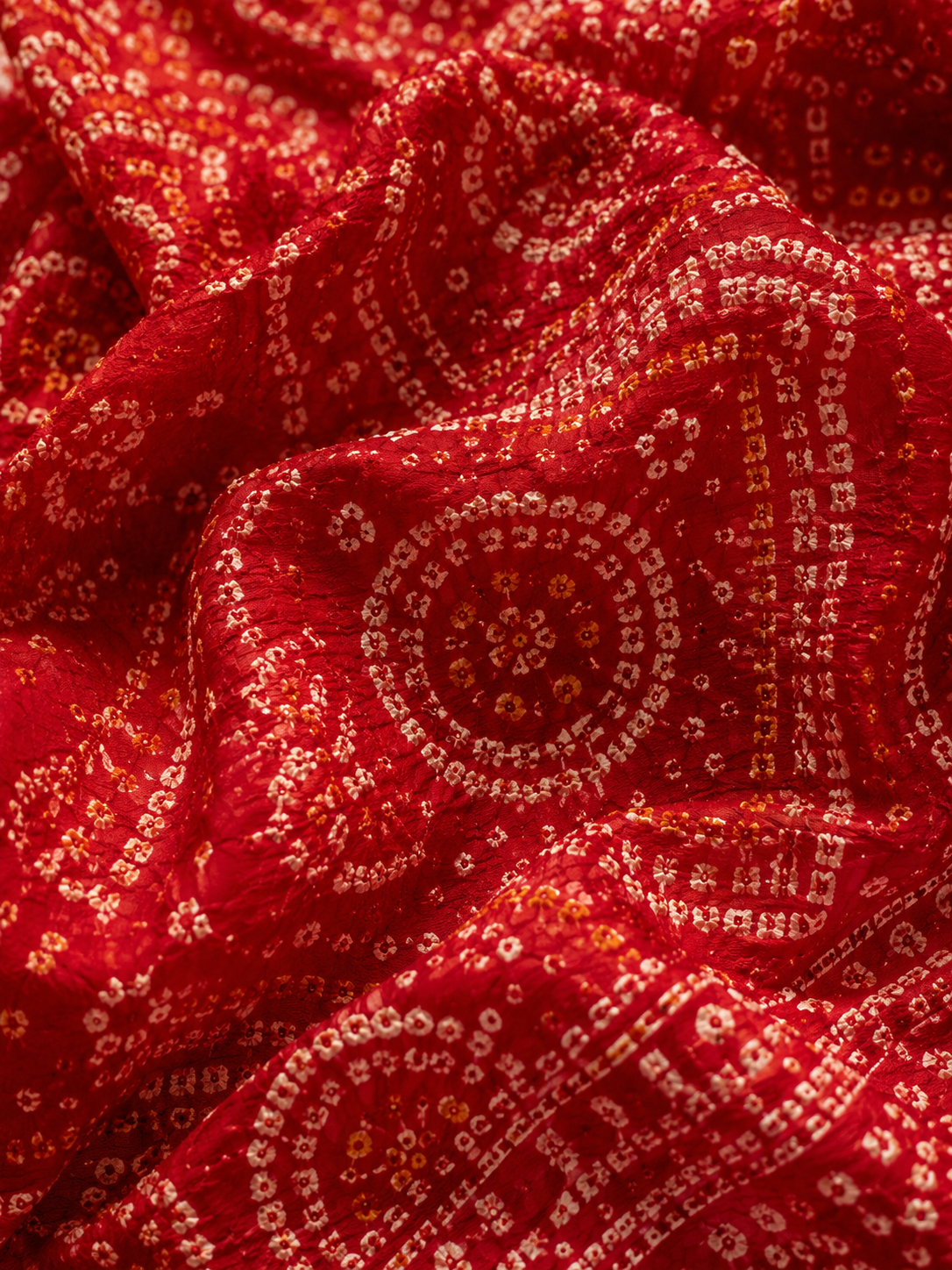
A genuine Bandhani saree can involve tens of thousands of individual knots, each one tied by hand before the fabric is dyed. It’s tie-dye taken to a level of precision most people don’t realize is possible without a machine — because a machine genuinely can’t do it.
01 — Origin
Where Bandhani comes from
Bandhani is most closely associated with Bhuj in Gujarat’s Kachchh region, along with parts of Rajasthan, where the technique has been practiced for centuries, historically by the Khatri community. The word “Bandhani” comes from the Sanskrit “bandhan,” meaning “to tie” — a literal description of the entire process.
02 — How it’s made
Tied, then dyed
Before any dyeing happens, the fabric is pinched into tiny points and tied off with thread, one point at a time — traditionally done by women using a fingernail technique to pinch precise, consistent points across the entire cloth. Once thousands of these tiny ties are in place, the fabric goes into a dye bath. The tied points resist the dye, leaving small undyed dots once the threads are removed — those dots form the pattern.
For multi-coloured designs, this ties-then-dyes process repeats for each colour, with new points tied and old ones sometimes opened depending on the design complexity — which is why elaborate multi-colour Bandhani pieces take considerably longer than single-colour ones.
Why it’s considered auspicious
Bandhani holds particular cultural significance for weddings and festivals across Gujarat and Rajasthan — it’s traditionally associated with monsoon festivals and is a common choice for bridal trousseau pieces, considered auspicious for new beginnings.
03 — How to tell it’s genuine
What to check
- Count the knot density up close. Genuine hand-tied Bandhani has slight variation in dot size and spacing — no two dots are perfectly identical. Screen-printed imitations have mechanically uniform dots.
- Look for a tiny raised texture at each dot. Where the fabric was pinched and tied, there’s often a very subtle puckering or texture at the center of each dot — flat, smooth dots suggest printing rather than tying.
- Check the reverse side. Genuine tie-dye shows the dye pattern clearly on the back as well, since the resist process affects the whole thickness of the fabric at each tied point.
- Ask about dye stability. Genuine Bandhani, especially with natural or semi-natural dyes, often needs a first gentle wash before colours fully set — a seller who mentions this upfront is more credible than one who doesn’t.
04 — What it costs
A rough price guide
| Type | What it means | Typical price |
|---|---|---|
| Screen-printed “Bandhani style” | Machine-printed dots, no actual tying | ₹800 – 2,000 |
| Hand-tied Bandhani, moderate density | Genuine tie-dye, standard dot pattern | ₹3,000 – 8,000 |
| Fine Bandhani, dense multi-colour work | High knot density, several dye passes | ₹10,000 – 25,000+ |
05 — Wearing and caring for it
Once you own one
Bandhani’s lightweight base fabric (typically cotton or georgette) and joyful colour palette make it well-suited to festive daytime occasions and monsoon-season events specifically, in keeping with its traditional cultural role. It pairs easily with simpler, understated jewellery since the pattern itself carries plenty of visual interest.
Hand-wash separately for the first three washes given the dye process, avoid wringing (which can distort the tied texture), and air-dry flat rather than on a hanger to preserve the puckered dot texture that defines the fabric.
06 — Common questions
Quick answers
How many knots does a real Bandhani saree have?
It varies significantly by design, but fine Bandhani work can involve tens of thousands of individual hand-tied points across a single six-yard saree — a genuinely labour-intensive process.
Is Bandhani the same as tie-dye?
Conceptually yes — both use a resist-tying technique before dyeing — but Bandhani refers specifically to the traditional Gujarati/Rajasthani craft with its characteristic fine dot patterns and cultural significance, distinct from broader Western tie-dye styles.
Why do Bandhani colours sometimes run in the first wash?
This is common with genuine dye processes and typically settles after the first one or two gentle hand-washes — always wash separately the first few times as a precaution.
Looking for genuine Bandhani?
We post hand-tied pieces in the WhatsApp circle as they arrive from Gujarat — real knots, real colour, no shortcuts.