HANDLOOM SAREES · UNSTITCHED SUIT MATERIALS · SOURCED DIRECTLY FROM WEAVERS · FREE SHIPPING ACROSS INDIA

GI Tag on a Saree: What It Means and Which Sarees Have One

Weave Spotlight · Quick Answer
GI tag on a saree.
What a GI tag on a saree means, which weaves carry one, what it does and does not promise, and how to check before you buy.
5-minute read · Weave Spotlight
You have probably seen “GI-tagged” on a Kanjivaram or Chanderi listing. Here is what a GI tag on a saree actually means, and what it does not promise.
01 — The short answer
What is a GI tag on a saree?
A GI tag on a saree is a legal label for a product from a particular place. GI stands for Geographical Indication. It tells you that a name, such as Kanjivaram or Chanderi, belongs to cloth made in a specific region, in the traditional way. In India it comes from the Geographical Indications of Goods (Registration and Protection) Act of 1999, and it exists to protect weavers and buyers from imitations that borrow the name.
02 — Why it matters
What the GI tag on a saree protects
Without a GI, anyone can sell a printed copy and call it Kanjivaram. With a GI, the name is tied to the region and to the way the product is made. This helps weaving communities that have worked on a craft for generations, because they can stop others from using the name for something else. For buyers, a GI tag on a saree is a reason to trust that the name means something.
03 — Examples
Sarees with a GI tag
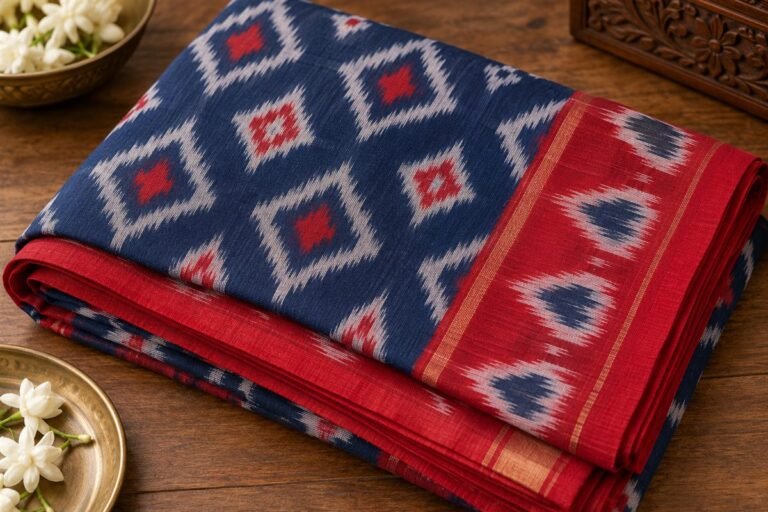
Several of the weaves we write about carry a GI registration, among them Kanjivaram (Kancheepuram silk), Banarasi brocades and sarees, Chanderi, Paithani, Pochampally ikat, and Patan Patola. You can read about each in our guides to Kanjivaram, Benarasi, Chanderi, Paithani, and Patola.
Read it carefully
A GI tag protects the name and the method, but it does not guarantee every saree sold under that name is handwoven. Ask the seller whether the piece is handloom, and what proof they have.
04 — How to check
Checking the GI tag on a saree
Genuine GI products usually come with a logo, a tag, or a certificate from an authorised producer. Ask to see it, and ask where the saree was woven. Be wary of a tag that looks printed on later, or a seller who cannot say where the cloth is from. A GI tag on a saree is a useful signal, but it works best together with the other checks in our guide to telling a real handloom saree from a fake and our price guide.
05 — Beyond the tag
A GI tag on a saree is the start, not the end
A GI tag on a saree tells you the name is legitimate, but it does not tell you whether a specific piece is a good one. Quality still varies within a GI category, from a simple everyday piece to a masterwork that took months. Use the tag to confirm the origin, then use your eyes and the price guide to judge the work itself.
It also helps to know what a GI tag cannot do. It does not set the price, it does not describe the fibre, and it does not replace a trustworthy seller. When you buy, ask who the weaver is, where the loom is, and whether you can see a photo or video of the saree before it is sent. Those answers matter as much as the label.
06 — Common questions
Quick answers
What does GI tag mean on a saree?
GI means Geographical Indication. It is a legal label that ties a name, such as Kanjivaram or Chanderi, to a specific region and traditional method of making.
Does a GI tag mean a saree is handloom?
Not automatically. It protects the name and the method, so ask the seller whether the particular piece is handwoven.
Which sarees have a GI tag?
Several, including Kanjivaram, Banarasi, Chanderi, Paithani, Pochampally ikat, and Patan Patola.
How can I check a GI tag?
Ask to see the logo, tag, or certificate from an authorised producer, and ask where the saree was woven.
Have a question about a saree?
Tell us which saree and weave you are looking at over WhatsApp, and we will tell you honestly what to check.