HANDLOOM SAREES · UNSTITCHED SUIT MATERIALS · SOURCED DIRECTLY FROM WEAVERS · FREE SHIPPING ACROSS INDIA

Kanjivaram Saree Guide: How to Spot a Genuine One

Weave Spotlight · The Craft
Kanjivaram saree:
the weave that
never wears out.
The temple silk of South India, explained — the korvai technique that sets it apart, what it should cost, and how to check a piece is genuine.
7-minute read · Weave Spotlight
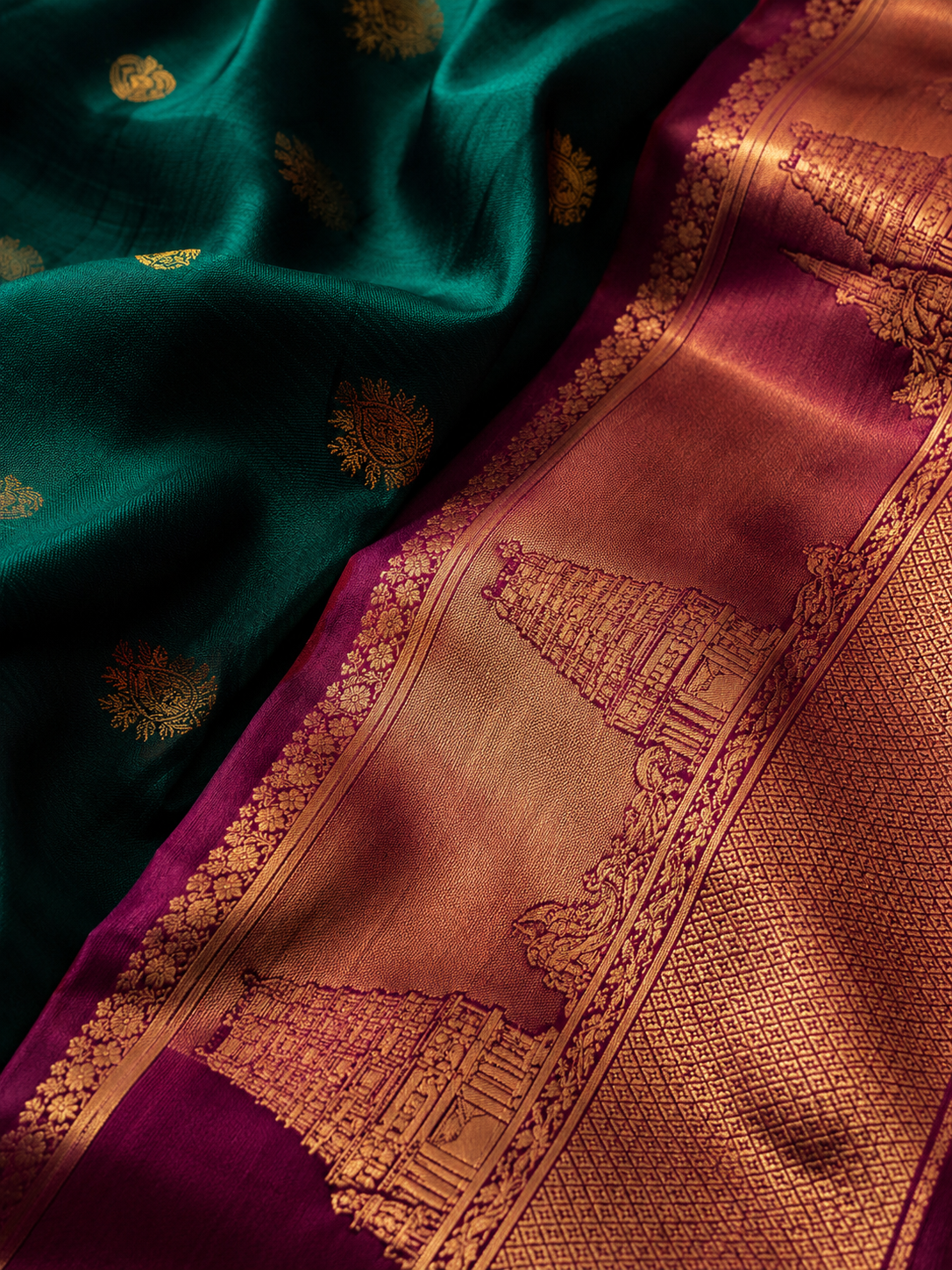
A well-made Kanjivaram saree can outlast the person who bought it — passed from mother to daughter for three generations without losing its structure or shine. Here’s what makes that possible, and how to spot a real one.
01 — Origin
Where the Kanjivaram comes from
Kanjivaram (also called Kanchipuram) silk comes from the temple town of Kanchipuram, Tamil Nadu — a weaving tradition documented as far back as the Chola dynasty, over a thousand years ago. Local legend credits the craft to weavers descended from sage Markanda, said to have woven cloth for the gods themselves. Whether or not you take that literally, the town’s identity has been inseparable from silk weaving for centuries.
Today, Kanchipuram remains home to thousands of handloom families, many still working from the same looms passed down within a household for generations.
02 — What makes it different
The korvai technique
A Kanjivaram’s defining feature is korvai — a technique where the body and the border of the saree are woven separately, often in contrasting colours, using three separate shuttles, then interlocked together at the point where they meet. Done well, the join is strong enough that the border can outlast the body of the saree by decades without fraying apart.
This is also why a genuine Kanjivaram border is never printed or embroidered on — it’s structurally woven into the fabric itself, which is the easiest tell between a real piece and an imitation.
Why it’s so durable
Kanjivaram sarees use heavy mulberry silk with a high thread count, which is part of why genuine pieces feel stiffer when new — that stiffness is a sign of density and quality, not a flaw, and softens naturally with a handful of wears.
03 — How to tell it’s genuine
Four things to check
- The border join. Run a finger along where the border meets the body — a real korvai join has a very slight ridge or thickness change. A flat, seamless transition usually means the border was woven in the same pass, not interlocked separately.
- Zari weight. Genuine Kanjivarams traditionally use real zari (silver wire, gold-plated) — heavier, with a slightly duller sheen than synthetic metallic thread, and noticeably heavier in hand.
- Silk feel. Pure mulberry silk has a distinct crisp-but-soft handle. Art silk or blended versions feel slippery or unnaturally smooth.
- The price floor. A true korvai Kanjivaram with real zari rarely starts below ₹20,000–25,000. Pieces priced at ₹3,000–5,000 claiming “pure Kanjivaram silk” are almost always art silk or powerloom imitations.
04 — What it costs
A rough price guide
| Type | What it means | Typical price |
|---|---|---|
| Art silk, printed border | Machine-woven, imitation zari — everyday wear | ₹2,000 – 5,000 |
| Handloom silk, machine zari | Genuine weave, synthetic metallic thread border | ₹8,000 – 18,000 |
| Handloom silk, real zari, korvai | Full traditional construction, interlocked border | ₹25,000 – 60,000 |
| Heirloom / temple-border masterweaves | Dense zari work, rare motifs, named weaver | ₹75,000+ |
05 — Wearing and caring for it
Once you own one
Expect a new Kanjivaram to feel stiff for the first few wears — this softens naturally and isn’t a defect. Because of its weight and structure, it holds pleats exceptionally well, which is part of why it’s such a popular bridal and formal choice across South India.
Dry-clean only, and store flat wrapped in muslin with neem leaves to deter moths — never on a hanger, since the weight of the silk and zari can strain and eventually tear at the shoulder. For a full fabric-by-fabric routine, see our Care & Repair guide below.
06 — Common questions
Quick answers
Is Kanjivaram the same as Kanchipuram silk?
Yes — Kanjivaram and Kanchipuram silk refer to the same saree, named after the town of Kanchipuram. “Kanjivaram” is simply the more commonly used name.
Why do Kanjivaram sarees feel so heavy?
A combination of dense mulberry silk, real zari thread, and the korvai border construction — a full six-yard piece often weighs 700g–1kg or more, which is part of what gives it its structured drape.
Can the zari be restored if it tarnishes?
Yes, similar to Benarasi zari — a skilled karigar can re-work tarnished zari, typically for a few hundred rupees, restoring much of the original shine.
Looking for a genuine Kanjivaram?
We post authentic handloom pieces in the WhatsApp circle as they arrive from Kanchipuram weavers — no restocks, no mass production.
[…] and more festive than earlier in the puja. This is where a proper silk earns its place. Benarasi Kanjivaram Dashami Red, and expendable Sindoor Khela — married women smearing vermillion on each other […]
[…] necklace and jhumkas is close to a formula at this point, and formulas exist because they work. Kanjivaram Benarasi Temple jewellery South Indian silk’s natural partner Temple jewellery — coin […]
[…] it’s the one part of the day where a heavier, more formal handloom earns its place. Benarasi Kanjivaram Moonrise & after Whatever you’re already wearing By the time the moon actually rises, […]