HANDLOOM SAREES · UNSTITCHED SUIT MATERIALS · SOURCED DIRECTLY FROM WEAVERS · FREE SHIPPING ACROSS INDIA

Pochampally Ikat Saree: Tie-Dyed Yarn, Woven Pattern

Weave Spotlight · The Craft
Pochampally ikat:
dyed before the loom.
The Pochampally ikat saree of Telangana is made from tie-dyed yarn, woven into soft-edged geometric patterns. Origin, how to tell a real one, price, and care.
6-minute read · Weave Spotlight
A Pochampally ikat saree is dyed before it is woven, which is why its patterns have that soft, feathered edge. Here is how the craft works, and how to tell a real one.
01 — Origin
Where does a Pochampally ikat saree come from?
A Pochampally ikat saree takes its name from Pochampally, a weaving town in Telangana, and the region around it. The weave is protected by a GI registration, and it is one of the best-known ikat traditions in India. It is made in cotton, silk, and silk-cotton, and it is easy to recognise by its bold geometric designs with softly blurred edges.
02 — What makes it different
Dyed first, woven second
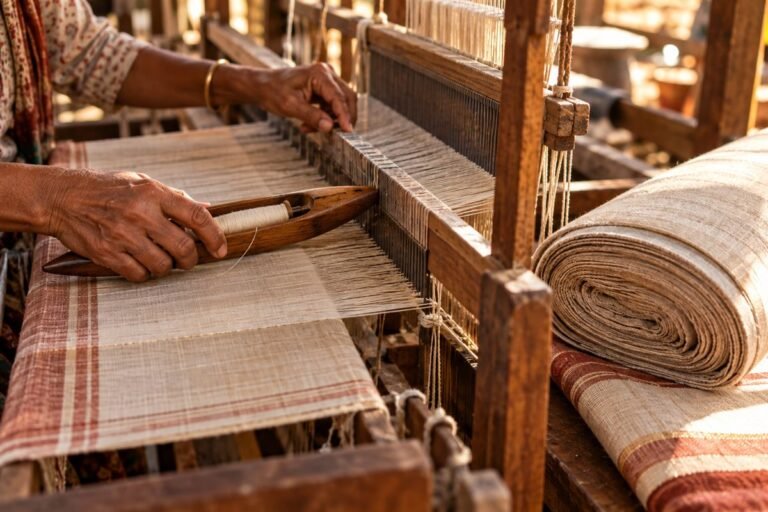
The word ikat comes from a Malay word meaning to tie or bind, and it describes the method. Before weaving begins, the yarn is bound in sections and dyed, so that the colour is set in the thread itself. The weaver then arranges the dyed threads on the loom so that the pattern appears as the cloth is woven. Because the threads shift very slightly as they are woven, the edges of each motif are softly feathered, not sharply drawn. That gentle blur is the signature of a genuine Pochampally ikat saree.
Ikat can be done on the warp, on the weft, or on both, and the more of it that is done in the dyed yarn, the more time the saree takes. The designs are usually geometric: diamonds, zigzags, and stepped patterns in strong colours.
Ikat is not only Pochampally
Ikat is made in other places too, including Odisha and Gujarat. The Patola of Patan is a famous example of the technique, with a very different look.
03 — Wearing it
Cotton for the day, silk for occasions
Pochampally cotton is light, comfortable, and affordable, which makes a Pochampally ikat saree a good everyday or office choice. Pochampally silk and silk-cotton are richer, and they suit festivals and family functions. The strong geometric pattern pairs well with a plain contrast blouse, and our blouse designs guide explains the options. For a saree to wear all day, see our guide to wearing a saree to work.
04 — How to tell it is genuine
Checks and a rough price
Look at the edges of the motifs: genuine ikat has a soft, slightly feathered edge, while a print has a sharp, even one. Turn the saree over, because in real ikat the pattern is part of the yarn and shows on the reverse almost as clearly as on the front. Feel the cloth and watch the price. As a rough guide, a Pochampally cotton ikat saree costs about ₹2,500 to ₹6,000, and silk or silk-cotton pieces cost considerably more. These are rough ranges, not a price list. A “Pochampally” saree at a very low price is likely to be a print. Our handloom saree price guide and guide to real handloom versus fake explain how to read these signs.
05 — Care
Keeping the colour fresh
Wash a Pochampally ikat saree separately and gently in cold water, since the dyes can bleed in the first washes. Dry it in the shade, and iron it on a medium setting from the reverse. Silk and silk-cotton are best dry cleaned.
06 — Common questions
Quick answers
What is a Pochampally ikat saree?
A handwoven saree from Pochampally in Telangana, made from yarn that is tie-dyed before weaving, so the pattern forms as the cloth is woven.
How do I tell Pochampally ikat from a print?
Look for softly feathered edges on the motifs, and check that the pattern shows on the reverse side too.
Is Pochampally ikat good for daily wear?
Yes. The cotton versions are light, comfortable, and affordable.
How much does a Pochampally ikat saree cost?
Roughly ₹2,500 to ₹6,000 for cotton, and more for silk. These are rough ranges, not a price list.
Looking for a Pochampally?
Tell us your occasion and budget over WhatsApp and we will tell you honestly what is available in ikat.