HANDLOOM SAREES · UNSTITCHED SUIT MATERIALS · SOURCED DIRECTLY FROM WEAVERS · FREE SHIPPING ACROSS INDIA

Benarasi Saree Guide: How to Tell Real Handloom from Powerloom

Weave Spotlight · The Craft
Benarasi saree:
a complete guide
to the real thing.
Everything worth knowing before you buy one — how it’s actually made, what separates handloom from powerloom, what it should cost, and how to wear it.
8-minute read · Weave Spotlight
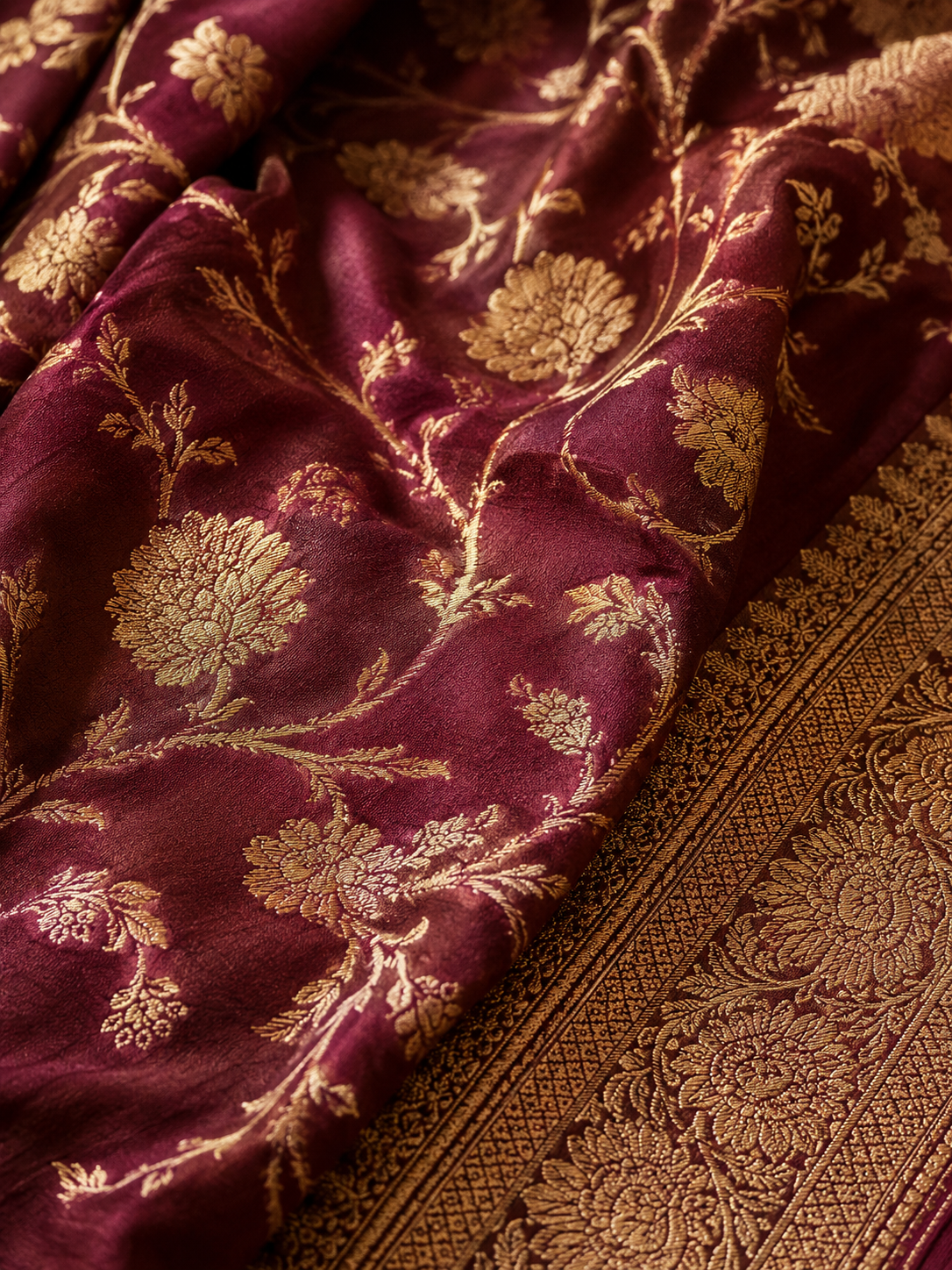
Type “Benarasi saree” into any marketplace and you’ll get thousands of results in minutes, most of them powerloom pieces sold at handloom prices. Here’s how to actually tell the difference — and everything else worth knowing before you buy one.
01 — Origin
Where the Benarasi comes from
The Benarasi saree takes its name from Varanasi (Benaras), Uttar Pradesh, where it has been woven for over 500 years. Its roots trace to Mughal-era court weaving, when Persian brocade techniques merged with Indian silk traditions — the result was a fabric rich enough for royalty and intricate enough to signal status at a glance.
Today, an estimated 1.2 million people across Varanasi and its surrounding villages still depend on the handloom weaving economy, though the number of families weaving genuine hand-loomed Benarasi silk has shrunk sharply as powerloom production has scaled.
02 — How it’s made
What actually goes into one saree
A genuine Benarasi is woven on a pit-loom, by hand, using a technique that interlaces silk with gold and silver zari thread (real zari is silver wire dipped in gold; most modern pieces use metallic polyester substitutes, which is fine as long as it’s disclosed). Depending on the intricacy of the brocade pattern, a single six-yard saree takes anywhere from 15 days to two months on the loom — sometimes longer for the most elaborate jaal (net) patterns.
Every motif — paisleys, florals, the iconic jaal lattice — is built into the weave itself using a supplementary weft technique, not printed or embroidered afterward. That’s the core distinction that makes a Benarasi a Benarasi, and it’s also exactly what a powerloom cannot replicate at any speed.
The honest number
Industry estimates suggest roughly 95% of “Benarasi” sarees sold online today are powerloom, not handloom — mechanically woven in a fraction of the time and sold at a fraction of the cost, often without disclosure. Powerloom isn’t inherently dishonest; selling it as handloom at handloom prices is.
03 — How to tell them apart
Handloom or powerloom? Check these five things.
- The reverse side. On a handloom piece, the back looks nearly as deliberate as the front — threads are carried and finished by hand. Powerloom backs are messier, with loose float threads.
- The selvedge (fabric edge). Handloom selvedges are woven clean, sometimes slightly uneven. Powerloom selvedges are stiff, machine-cut, and too perfectly straight.
- Pattern repeats. Handloom motifs have tiny human irregularities from row to row. If every repeat is identical down to the millimetre, it’s powerloom.
- The price. A genuine hand-woven silk Benarasi with real zari rarely sells below ₹8,000–10,000; elaborate pieces run well into ₹25,000+. Anything under ₹3,000 claiming to be handloom silk zari work almost certainly isn’t.
- Certification. Look for the India Handloom Mark or a Banaras Brocades and Sarees GI (Geographical Indication) tag — not a guarantee on its own, but a meaningful signal when present.
04 — What it costs
A rough price guide
| Type | What it means | Typical price |
|---|---|---|
| Powerloom, art silk | Machine-woven, synthetic zari — mass market | ₹1,500 – 4,000 |
| Handloom, silk-blend, machine zari | Hand-woven base, synthetic metallic thread | ₹6,000 – 12,000 |
| Handloom, pure silk, real zari | Full handloom, silver-gilt thread, fine jaal work | ₹15,000 – 40,000+ |
| Heirloom / master weaver pieces | Named weaver, rare motifs, museum-grade | ₹50,000+ |
Prices vary with silk quality, zari density, and the complexity of the motif — a plain-body Benarasi with a rich border costs meaningfully less than a full jaal pattern across the entire six yards.
05 — Wearing and caring for it
Once you own one
A Benarasi is a heavy, formal silk — built for weddings, festivals, and occasions where its weight and shine are the point, not a drawback. It pairs naturally with statement jewellery and a contrast blouse, since the saree itself is already the centrepiece.
Care-wise: dry-clean only, store flat wrapped in muslin (never plastic, never hung on a hanger — the zari weight tears at the shoulder over time), and refold along a different line every few months to avoid crease damage. We’ve written a full fabric-by-fabric care guide if you want the complete routine — see below.
06 — Common questions
Quick answers
Is a Benarasi saree always silk?
Traditionally yes — pure mulberry silk is standard. Silk-cotton and synthetic blends exist at lower price points, but a “Benarasi” in the classical sense refers to the silk brocade version.
How do I know if the zari is real?
Real zari has a slightly duller, warmer shine and some tarnish resistance issues over decades; synthetic zari is brighter and more uniform but doesn’t age the same way. A burn test on a loose thread (real zari residue differs from plastic-coated thread) is the definitive check, but honestly — buying from a source that discloses this upfront is easier than testing it yourself.
Can a Benarasi saree be repaired if the zari tarnishes?
Yes — re-zari work by a skilled karigar typically costs ₹400–800 and can restore the shine. It’s a common, well-understood repair, not a sign the piece is ruined.
Looking for a real Benarasi?
We post genuine handloom pieces in the WhatsApp circle as they come in from the loom — no restocks, no mass production, no guessing whether it’s real.
[…] be heavier and more festive than earlier in the puja. This is where a proper silk earns its place. Benarasi Kanjivaram Dashami Red, and expendable Sindoor Khela — married women smearing vermillion on […]
[…] and jhumkas is close to a formula at this point, and formulas exist because they work. Kanjivaram Benarasi Temple jewellery South Indian silk’s natural partner Temple jewellery — coin motifs, […]
[…] and it’s the one part of the day where a heavier, more formal handloom earns its place. Benarasi Kanjivaram Moonrise & after Whatever you’re already wearing By the time the moon […]